



On January 27, 2026, leading voices from central banking, finance, and policy converged in Frankfurt for a crucial conversation about the future of money.
The 14th ILF Conference, co-chaired by Andreas Dombret (former German Central Banker, Chair of N26) and Patrick Kenadjian (Adjunct Professor at Institute for Law and Finance, Goethe University) brought together an impressive list of heavyweights including Barry Eichengreen from UC Berkeley, Lucrezia Reichlin from London Business School, Lorenzo Bini Smaghi from Société Générale, Fritzi Köhler-Geib from Deutsche Bundesbank, Jean-Pierre Landau former Banque de France, Klaas Knot former Dutch Central Bank, Thomas Vlassopoulos from the ECB, Hyun Song Shin and Gaston Gelos from BIS, members of the European Parliament and the European Commission, and executives from major financial institutions such as Martina Weimert.
The day’s mission: to debate stablecoins, tokenised deposits and CBDCs, and Europe’s position and path forward. I attended the conference and paid close attention to what was said during the whole day, and interacted with many participants in one to one. Here’s a glimpse of what I took away from it.
The American Strategy: Stablecoins as a Tool for Dollar Dominance
The conference opened with Berkeley economist Barry Eichengreen laying bare the geopolitical reality: the GENIUS Act in the US represents a deliberate strategy to solidify dollar dominance through stablecoins. As Eichengreen noted, American policymakers have been remarkably explicit about their intentions to use stablecoins to reaffirm dollar supremacy on the global stage.
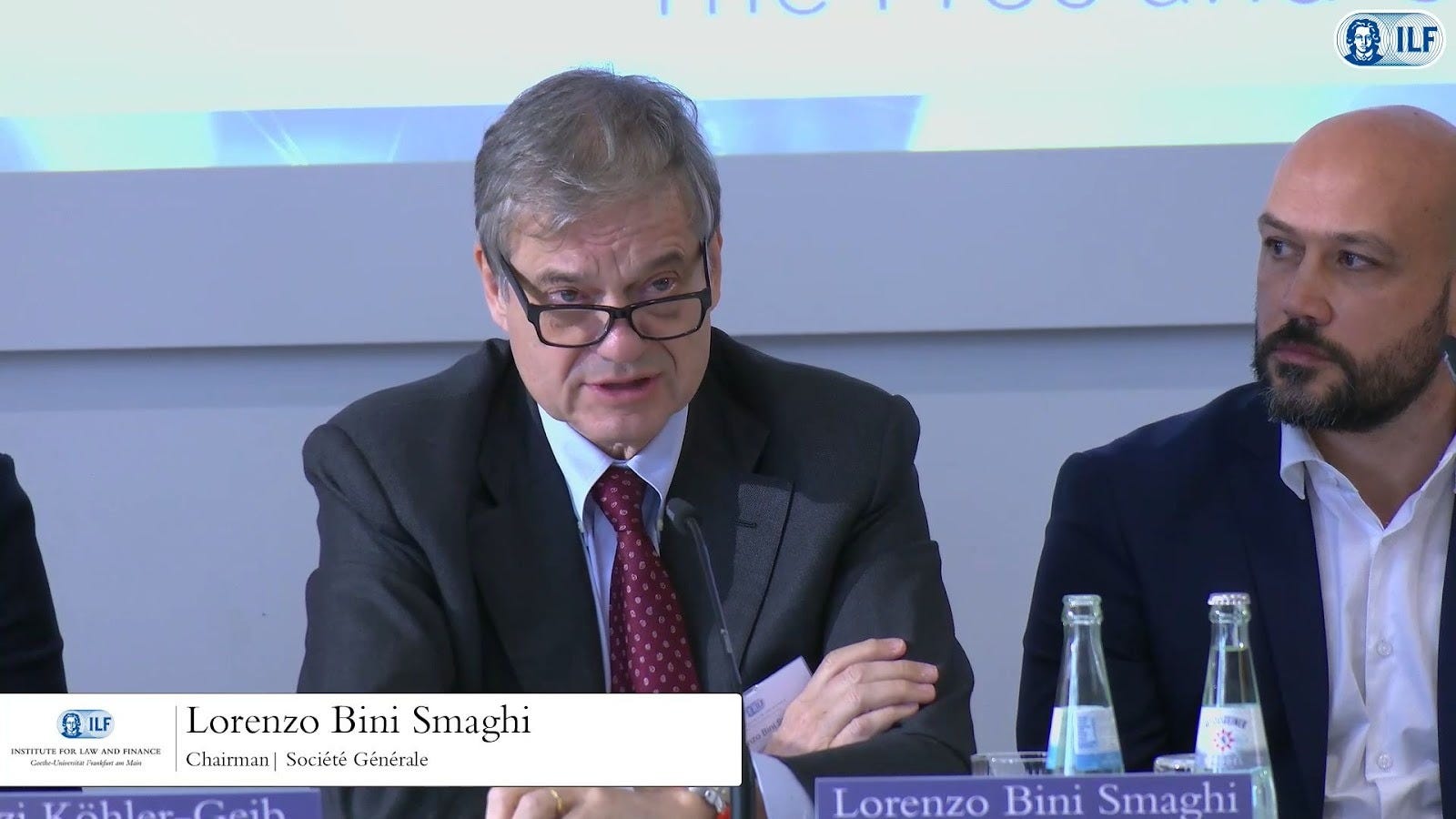
This framing set the stage for a day of discussions that revealed both clarity about the challenge and considerable uncertainty about the appropriate response. Lorenzo Bini Smaghi reinforced this view, observing that stablecoins now form part of the U.S. National Security Agenda. They are not only a complement to Treasury demand, but (as the Fed’s Stephen Miran made clear a few months ago) a weapon for further dollarization and a tool to increase dollar adoption in the emerging tokenized economy.
Europe’s Prisoner Dilemma: Five Possible Responses
Eichengreen outlined five potential European responses, each with significant drawbacks:
Do nothing, assuming stablecoins won’t enter the mainstream. This was deemed highly risky. While currency substitution isn’t currently problematic due to low inflation, it could rapidly become an issue if conditions change.
Ban dollar stablecoins, following China’s approach. However, as countries like Bangladesh, Indonesia, and Vietnam have discovered, users find workarounds through VPNs and other means, making enforcement impractical.
Issue competing euro stablecoins, like Japan, Hong Kong, and Singapore. The problem: Europe has significant catching up to do and would likely move too slowly to be effective.
Deploy a competing retail CBDC. While China’s e-CNY and initiatives like mBridge exist, these solutions remain small-scale and not yet scalable. mBridge, for instance, has processed only 200 transactions totaling $1.4 billion, compared to SWIFT’s 45 million transactions and $5 trillion daily.
Link faster payment systems across borders. These are typically not blockchain-based, work only within specific regions, and take considerable time to implement, around three years.
I found Eichengreen’s recommendation particularly wise: Build the ecosystem and continue engaging on multiple fronts, a pragmatic acknowledgment that no single silver bullet exists.
The Digital Euro Debate: A Chorus of Skepticism
Perhaps the most striking theme throughout the conference was the near-universal criticism of the European Central Bank’s focus on a retail digital euro. Speaker after speaker questioned whether this represented a strategic misstep that was consuming resources and attention that should be directed elsewhere.
