



This essay is the first in a two-part series exploring why there will be no Plaza Accord 2.0 between China and the US, and why AI plays a crucial role in the debasement of the dollar.
Every relationship teaches the same lesson sooner or later. With enough power you can force someone to change, however the change rarely lasts and rarely goes the way you planned. The older version of that wisdom, the Buddhist one, is even simpler: control what you can control, that is, your own actions and your reactions, and stop trying to control others. Nations learn it more slowly than people do, but it binds them all the same.
At present, from a monetary perspective, America and China are each doing what they can to manage their respective positions. Both nations remain locked in what looks like a dangerous imbalance: America is running ever-larger twin deficits (simultaneously a fiscal (budget) and a current account deficit (trade)), while China continues to expand its massive trade surplus. Against this backdrop, much of the commentary still looks to a grand bargain to realign their currencies: a Plaza Accord 2.0.
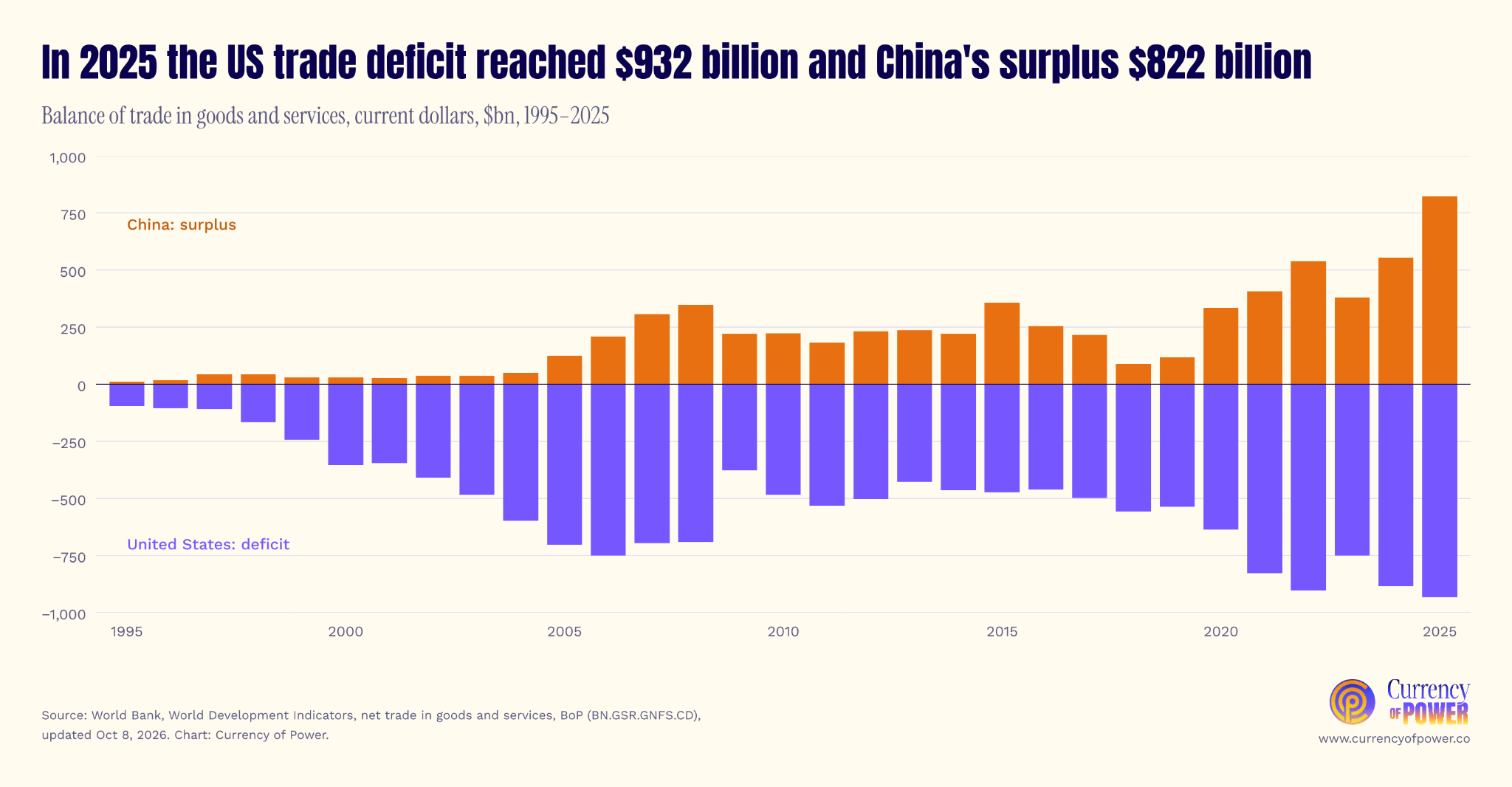
We think that in fact, the realignment is already under way, and it will come through the debasement of the dollar… with no accord at all!
What Plaza was
What was the Plaza Accord exactly? By 1985 the dollar was badly overvalued, the result of the so-called Volcker squeeze. To break the inflation of the 1970s, Fed chair Paul Volcker had pushed interest rates to around 20% in 1980–81. As a result, global capital poured into dollars to earn those rates, and by early 1985 the dollar had risen roughly 50%, pricing American manufacturers out of world markets and swelling the trade deficit. In reaction, Congress was drafting protectionist bills.
Something clearly had to be done. That September, the finance ministers of the US, Japan, West Germany, France and Britain met at the Plaza Hotel in New York. They agreed to push the dollar down together: their central banks would sell dollars on the open market, and Japan and Germany would let their currencies rise.
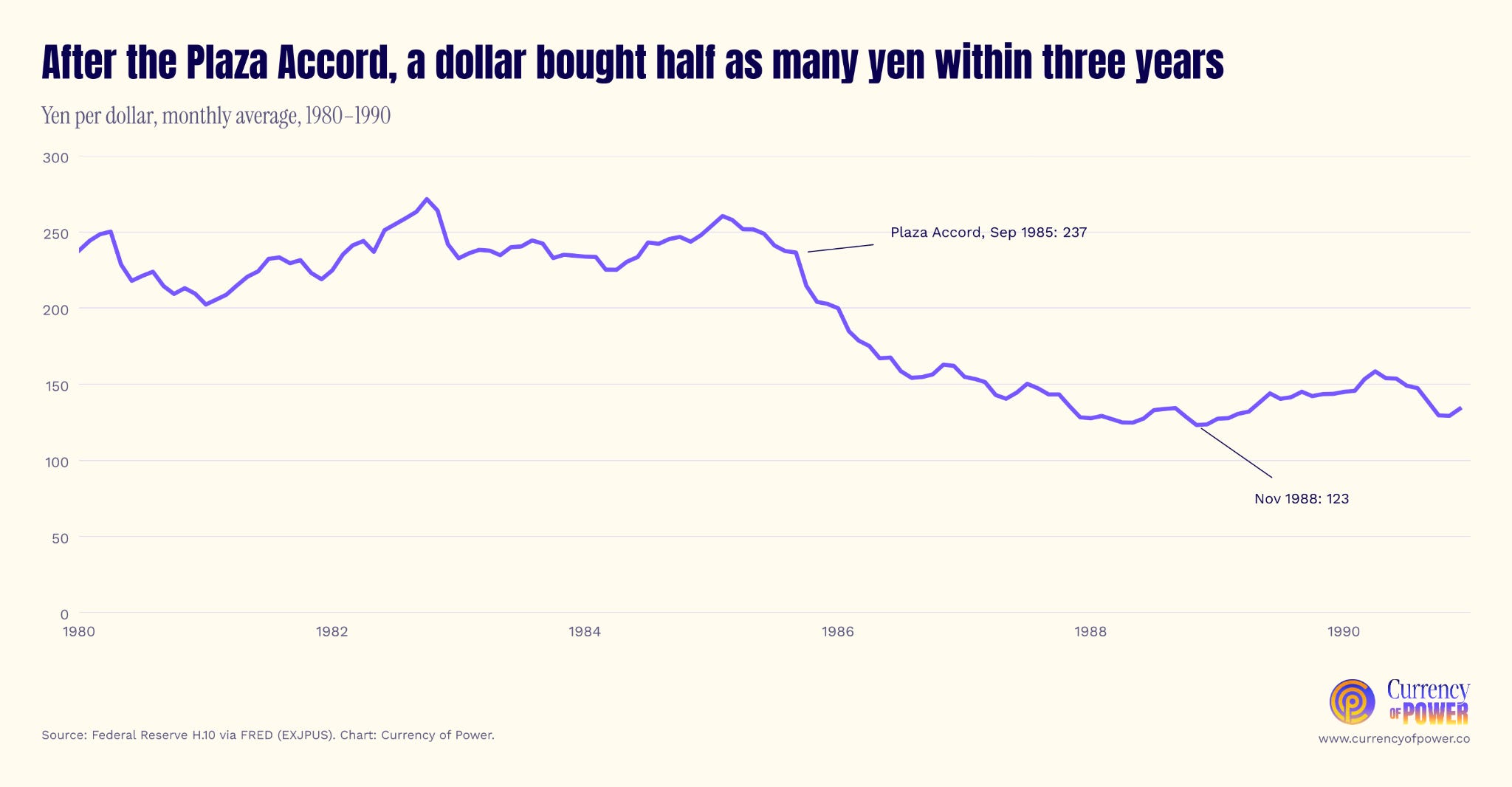
It worked—fast! The yen went from about 240 to the dollar to about 120 within three years. But in retrospect, many say it only worked because America had leverage. Both post-war Japan and West Germany were security dependents with American troops on their soil. Tokyo also had reasons of its own for playing along. As Michael Pettis recently pointed out in a Substack essay, Japan’s current-account surplus had reached 3.6% of GDP, and Japanese economists had long worried about weak domestic demand. In 1986, the Maekawa Commission, set up by Prime Minister Nakasone, called for a “historic” shift from exports to domestic demand. A stronger yen was an integral part of that plan.
Today, none of those favorable conditions holds when it comes to China. Beijing sits entirely outside the American security umbrella. In addition, unlike Japan in 1985, it runs capital controls, sets a daily fixing exchange rate, and has spent four decades studying what seems to be its reading as the lesson of Plaza from the Japanese perspective: first a currency revalued under pressure, then an asset bubble, then a lost decade. To Beijing, 1985 Japan might have been willing to play along, but it lost a great deal in the process.
On Substack, Michael argues that this interpretation is wrong. In his view, Japan’s lost decades were not the result of the Plaza Accord, but of the Bank of Japan’s response to the stronger yen. To cushion the slowdown, the BOJ cut its discount rate from 5% to 2.5% between January 1986 and February 1987. The resulting cheap credit helped fuel a property and equity bubble that burst a few years later, plunging Japan into recession.
More generally, a negotiated revaluation, like the one Japan agreed to back in 1985, means hurting your own exporters on command—which China is not in a position to even consider, out of both self-interest and national pride. And so, right or wrong, Beijing’s reading shapes policy: no Chinese leadership will ever sign a Plaza Accord 2.0. And as we recently discussed on the Hidden Forces podcast, American soft power has eroded anyway, so the old coordination playbook is harder to run than it was in the 1980s.
Of course, there’s been a recent rapprochement between Washington and Beijing. Xi Jinping’s recent state visit to Washington put the two governments back at the negotiating table. But look at what was agreed: the trade truce extended to January 10, 2027, tariff cuts on $60 billion of goods, Chinese purchases of at least 10 million metric tons of US coal in 2027 and again in 2028, a communication channel for AI incidents, and Beijing’s pledge to approve foreign financial institutions, including those with US capital. A lot was discussed, but nothing was said about the exchange rate or a revaluation of the yuan.
Still, could all this pave the way for a Plaza Accord 2.0? In 1984, a year before the Plaza Accord, the Yen-Dollar Agreement pushed Japan to open its financial markets. First, Japan had to open up; then it would have to revalue its currency. Some will read the recent progress on the US-China front in the same way, but we don’t. In our view, as we’ve argued before, any opening by China will take place only through channels that Beijing controls and can narrow at will when circumstances demand it: licenses, Stock Connect, Bond Connect, and Hong Kong. In other words, as Japan in 1984, Beijing is willing to change who gets access to its financial markets. But unlike the open economy that Japan has been for a long time, it isn’t ready to let global markets determine its exchange rate.
In a recent talk at the University of Zurich, which Marieke attended, the China analyst Yanmei Xie described a shift in how Western governments see China. For decades the West hoped to change China’s economic model. They now accept that it will not change, and ask instead how to protect themselves from it. The same logic applies to the currency. Washington cannot make Beijing revalue the yuan the way it got Tokyo to revalue the yen in 1985. That is why we expect no Plaza 2.0. But Washington may not need one after all. The yuan has been rising anyway, on Beijing’s terms: the central bank set its daily reference rate at 6.72 per dollar on October 16, against 7.19 in early January 2025. What that reveals is that the rebalancing that Plaza once forced on the yen is now happening to the yuan without a treaty.
If nobody signs a treaty, what will do the work the Plaza Accord once did? How can a dollar that buys less every year in American shops still hold its value against the yuan? And who will pay for the adjustment: American savers, Chinese households, or Europe? The answers run through Washington’s debt, Beijing’s repressed savings, and the AI build-out now competing with the Treasury for the same money.
Debased at home, strong abroad
If no treaty is coming, the mechanism for rebalancing has to be the dollar itself. Specifically, two different things can happen to the dollar:
