



I have just come back from Hong Kong, a city I love and where I lived almost twenty years ago. Back then I was a financial analyst at LVMH, and the group was expanding across Asia, above all into mainland China, at a pace that still seems unreal. We were opening stores across the region at a phenomenal rate. The city was loud, rich, and sure of itself, and expats were living their best life.
Then came 2019: protests, of which several versions exist depending on who tells the story. Then Covid, and one of the toughest quarantine regimes anywhere. Many expats left. The city that remained felt a little sleepy, overshadowed by Shenzhen across the border, the shiny neighbor where things were now happening.
The easy conclusion is that Hong Kong’s moment has passed. Yet having spent a week back there, I think it is the wrong conclusion.
Hong Kong is vibrant again. But it is not trying to be what it used to be. It is becoming something new, and what it is becoming can tell us a great deal about the world order being redrawn around us.
A week in the room
I went for Hong Kong FinTech Week, the city’s flagship fintech gathering, co-organized by the Hong Kong Monetary Authority (HKMA) and InvestHK. The organizers expected more than 45,000 participants from over 120 economies; the week certainly felt that way. But as I was reminded, October and November are always packed in Hong Kong, after the typhoons and before the year-end rush.
I moderated panels (on stablecoins and on AI), joined side events and closed-door conversations, reconnected with old friends, and met new ones. I went to better understand what is happening and wanted to dig into three things: AI, stablecoins, and gold.
If I left with one impression, it is this: Hong Kong wants to be the next London or New York, but not a copy of either. It is not trying to rebuild the financial center of the last century. It wants to be the London or New York of the next one: a hub built for an AI-driven financial economy in a world that is reordering itself.
The gateway, reversed
Twenty years ago, Hong Kong was where Western companies tested products on Chinese customers before deciding whether to launch on the mainland. That is exactly what we did at LVMH.
Today the flow runs mostly the other way. Hong Kong is the platform where Chinese companies reach international capital and test run before expanding abroad.
International and local banks are competing hard for IPO mandates. Beijing has recently tapped the brakes: too many filings led by Chinese banks were of poor quality, and too many recent listings have disappointed. Part of the answer has been to push international banks to do more of the paperwork. And so despite the headlines, American banks are coming back to China in force, growing their business rather than shrinking it.
The crowd itself was very telling. Mainland Chinese are very much present in the Hong Kong business scene—many announcements made at the conference were in Putonghua. Alongside the usual European and American delegates, a striking share came from Kazakhstan, Uzbekistan, Kyrgyzstan, Azerbaijan, and Ukraine. Hong Kong is also no longer only a hub; it is a model for others to copy. Kazakhstan, for one, has built its free-trade zone and its rule-of-law offer on the Hong Kong template.
The talent market points the same way. Hong Kong now has several universities among the world’s best, is building more, and is attracting international researchers, including some who have left the US and are looking for a new home. Competition for talent is fierce: the best mainland graduates want to come (salaries are high and tax low), internationals are coming, and Hong Kongers are competing with both.
Beijing walks a fine line with Hong Kong, but it understands the value of letting Hong Kong be Hong Kong: a common-law, open-capital, dollar-linked window onto the world. The mainland cannot be that window itself. Hong Kong can.
A Chinese city on American money
Nicolas and I wrote about Hong Kong’s unique relationship to the dollar a few months ago in One Country, Two Currencies. It is a fascinating relationship, and one I kept pondering on during the week. So much of Hong Kong is often a paradox.
The HKMA wears two hats. It is the banking regulator. It also manages the Exchange Fund, which held HK$4.46 trillion (roughly US$570 billion) at the end of June 2026 and exists, first and foremost, to defend the Hong Kong dollar’s peg to the US dollar.
The peg, in place since 1983, works as a currency board: every Hong Kong dollar in the monetary base has to be backed by US dollars. The price is that Hong Kong imports American monetary policy whether or not it suits local conditions. When US inflation runs hot and Hong Kong’s stays flat, Hong Kong still lives with the Fed’s interest rates.
That is an uncomfortable arrangement, yet it is fundamental to China. The peg is what makes Hong Kong a trusted bridge between Chinese capital and global markets. A Chinese city running on American monetary policy is a paradox Beijing puts up with because it is so useful.
The rails we are not measuring
For years we have measured what we can see, meaning SWIFT, and ignored what we cannot. On SWIFT, the renminbi’s share of global payments hovers around 3%, which seems to settle the question. It does not.
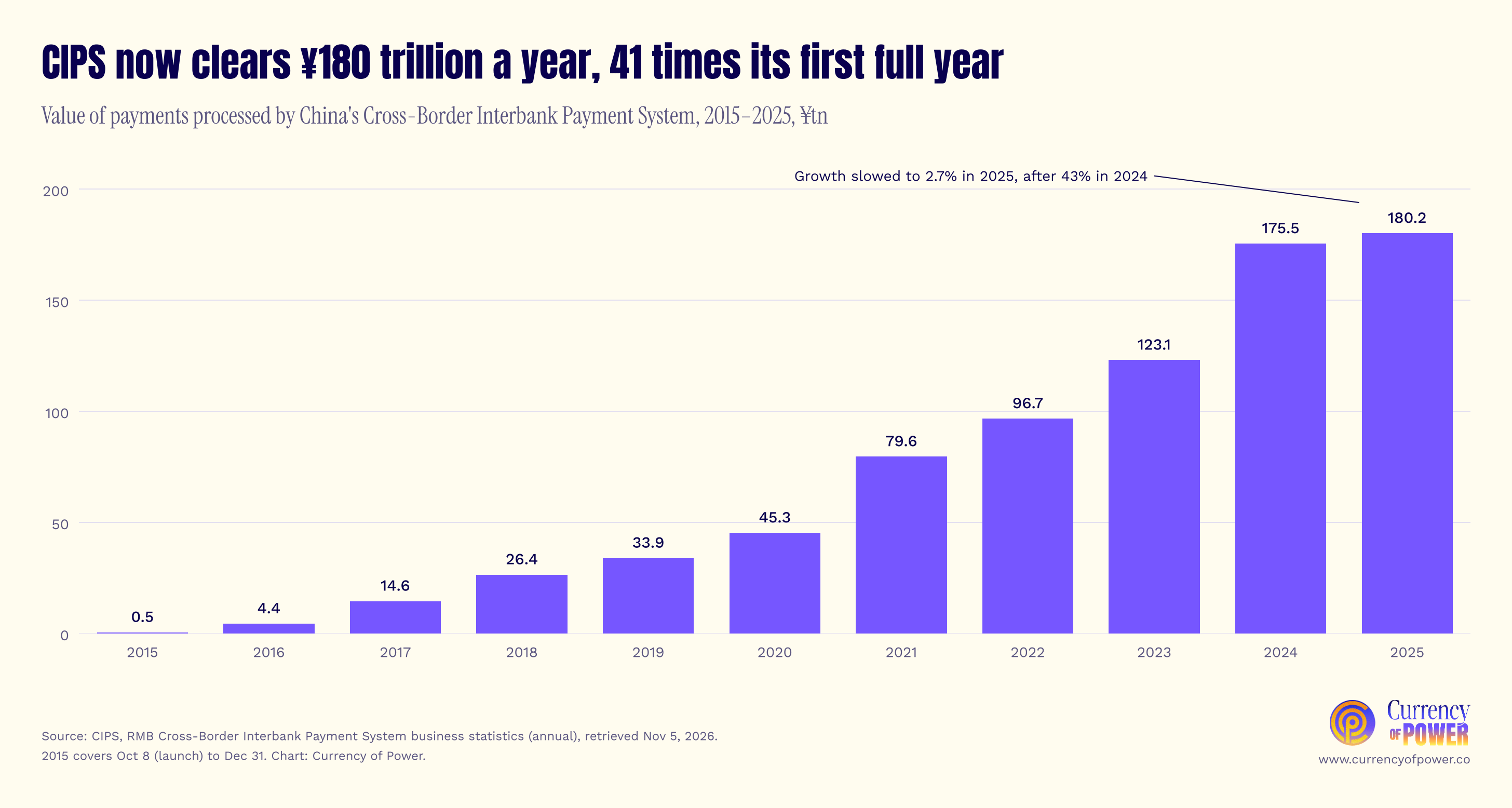
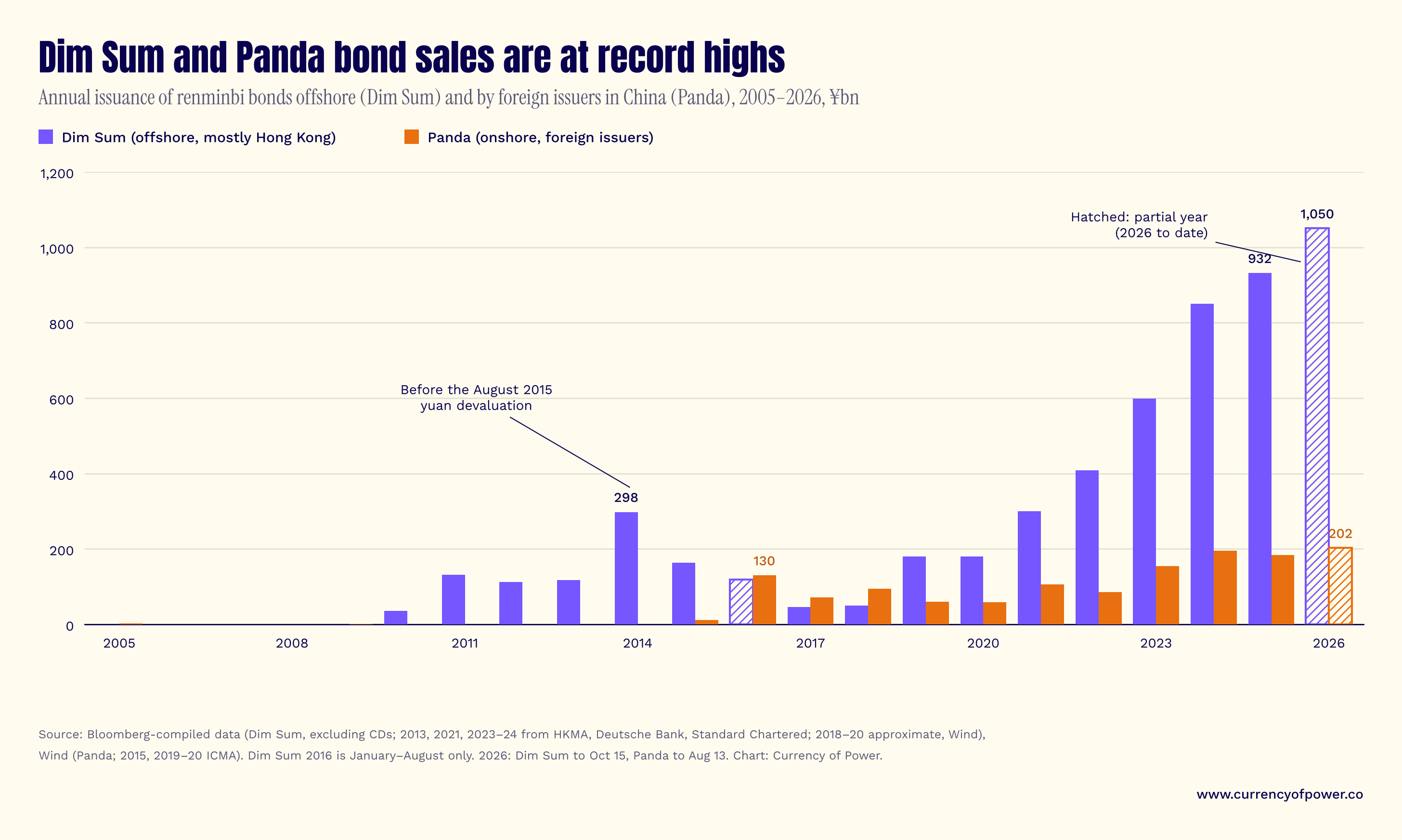
China’s own cross-border system, CIPS, processed RMB 175 trillion in 2024, up 43% in a single year, and about RMB 180 trillion in 2025. Overseas issuers raised a record RMB 195 billion in Panda bonds onshore in 2024, and the offshore Dim Sum bond market in Hong Kong is growing just as fast. A parallel set of financial rails is being built in plain sight, and our dashboards are mostly blind to it.
Gold: the anchor of trust
If there was one theme I did not expect to dominate the week, it was gold. The conference and its side events were full of gold, with a run of announcements about tokenized gold and gold that pays a yield.
I left with a certitude: gold sits at the center of the new financial architecture China is designing.
