

A new word appeared in the financial press last week: the chipdollar. On 16 November, Mallika Sachdeva, a strategist at Deutsche Bank, published a report arguing that the chipdollar is quickly replacing the petrodollar. Bloomberg‘s Odd Lots newsletter picked up the term a few days later.
Chipdollars are dollars earned by selling chips. Most of the chipdollars go to Taiwan and South Korea, which make most of the chips and the memory used across the AI world. With the surplus generated, these two countries invest a large part of their earnings back in the US—mostly into US stocks, including the AI companies that buy the chips. According to Deutsche Bank, world trade in semiconductors will become larger than world trade in oil and gas in 2026, for the first time.
The term may be new, but we at Currency of Power have been writing about this idea for a year. In Barrels to Bytes, published in November 2025, we argued that the successor to the petrodollar would come from AI, with computing power becoming the main commodity of this century. In our analogy, Nvidia was the new Aramco, and GPUs were the new barrels of oil. Buyers would pay for computing power in dollar stablecoins, and because stablecoin issuers must hold their reserves in US Treasury bills, every dollar spent on compute would end up financing the US government. We first called these stablecoins “cryptodollars,” then “computedollars.”
Then in The AI Oil Shock, published in September, we compared AI with the oil industry before the 1973 shock. According to this parallel, the next phase of AI may break apart its value chain and create a new commodity market for compute. At the bottom of that chain sits electricity, which is kind of the new oil. Unlike oil, though, it is hard to export; this is where compute and tokens come in.
How do the two ideas relate? Chipdollars and computedollars describe the same shift at two different stages. Chipdollars pay for the chips. Computedollars pay for the use of these chips once they run in data centers. Chips came first because they are the bottleneck today. Computedollars will take longer, because they need many more data centers that sell computing power by the hour.
And then a third stage will come after these two, which we call the “tokendollar.” To see where this journey leads, we first need to go back to the origin story: the petrodollar.
🇸🇦 The origin story: how the petrodollar worked; why it broke.
The petrodollar system started in 1974. Back then, it was said that Saudi Arabia agreed to sell its oil in dollars and to invest its surpluses in US government bonds. In exchange, the US guaranteed its security. The deal created a loop. Every country that imported oil needed dollars to buy it. The oil exporters earned these dollars and invested them in US Treasuries. This demand for US Treasuries kept interest rates low for the US government, which as a result could borrow more and import more. Bond prices move little, so the system gave the dollar stable support for 50 years.
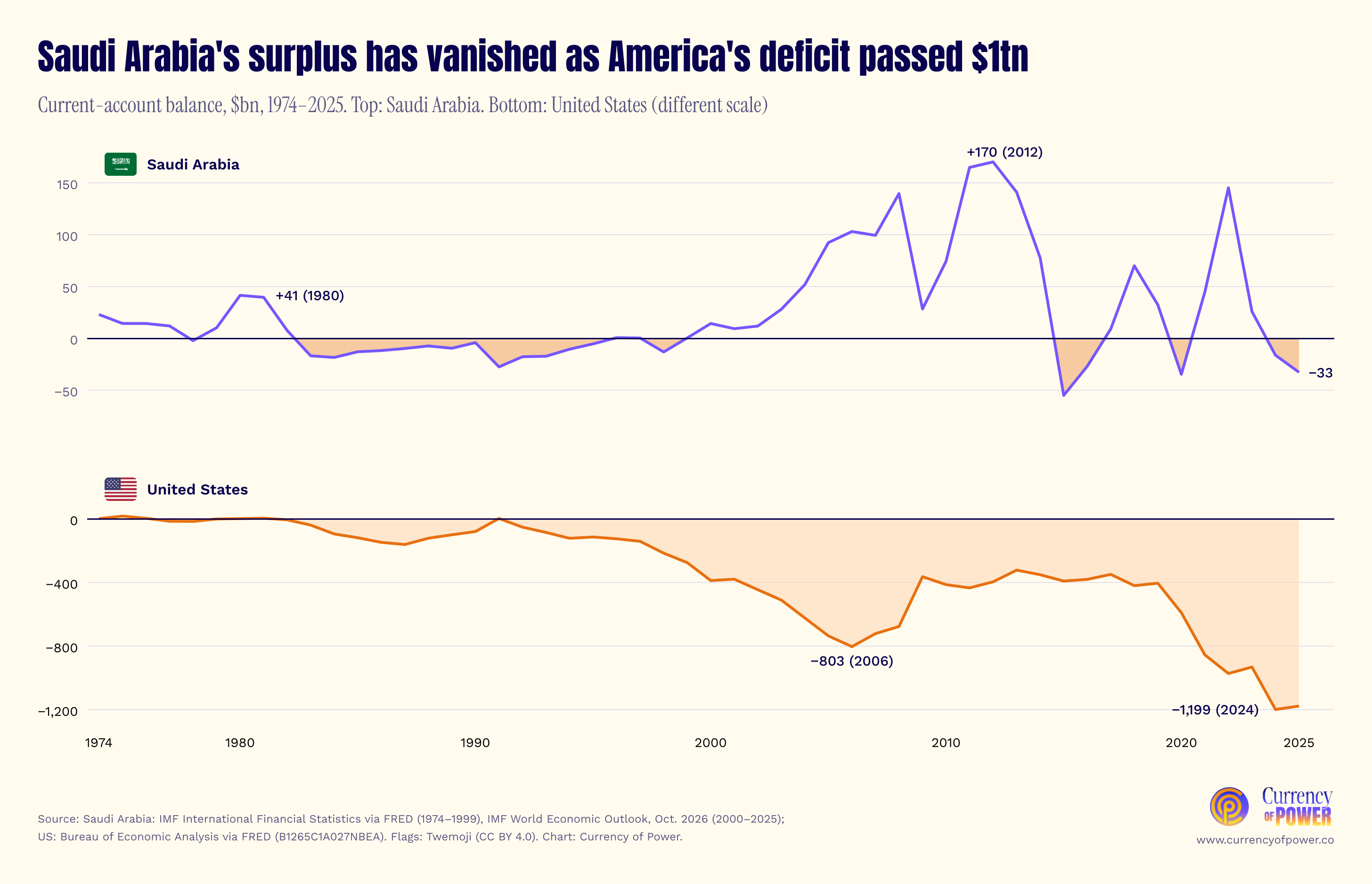
This loop no longer works, for two reasons. The first is that the Gulf surplus has shrunk. Saudi Arabia, the largest oil exporter, had a current-account surplus of $145bn in 2022. In 2025, it had a deficit of about $32bn. Lower oil revenue explains part of this. The rest of the gap comes from the country’s own spending: imports of services cost it more than $60bn a year, and foreign workers send a record amount of money home. A country with a deficit has no surplus to invest abroad. Meanwhile, the US current-account deficit, which petrodollars once helped to finance, passed $1tn in 2024. Saudi’s neighbors still have surpluses, but these are shrinking too: together, Saudi Arabia, the UAE, Kuwait, and Qatar earned $338bn in 2022 and $120bn in 2025.
The second reason is the war with Iran. Since 28 February, oil has had trouble leaving the region. Saudi Arabia sends most of its exports through Yanbu, on the Red Sea, to avoid the Strait of Hormuz. Higher prices gave it a surplus in the first quarter of 2026, but it went back to a deficit in the second quarter, and the IMF now expects the Saudi economy to shrink by 3.3% this year. In March of this year, in Petrodollars vs. Electroyuans, we argued that the war had broken the petrodollar system. Since then, the question has been what would replace it.
🇹🇼🇰🇷 From barrels to chips: the Chipdollar
The answer, for now, is chips. In 2025, Taiwan and South Korea had a combined current-account surplus of $307bn. Saudi Arabia, the UAE, Kuwait, and Qatar had $120bn. Taiwan’s surplus reached almost 20% of its GDP. In the first half of 2026 alone, Korea earned $191bn, more than in the whole of 2025. According to Mallika Sachdeva, Korea’s trade surplus in chips is close to $250bn, which is equal to its entire trade surplus. The IMF expects the gap with the Gulf to widen further in 2026.
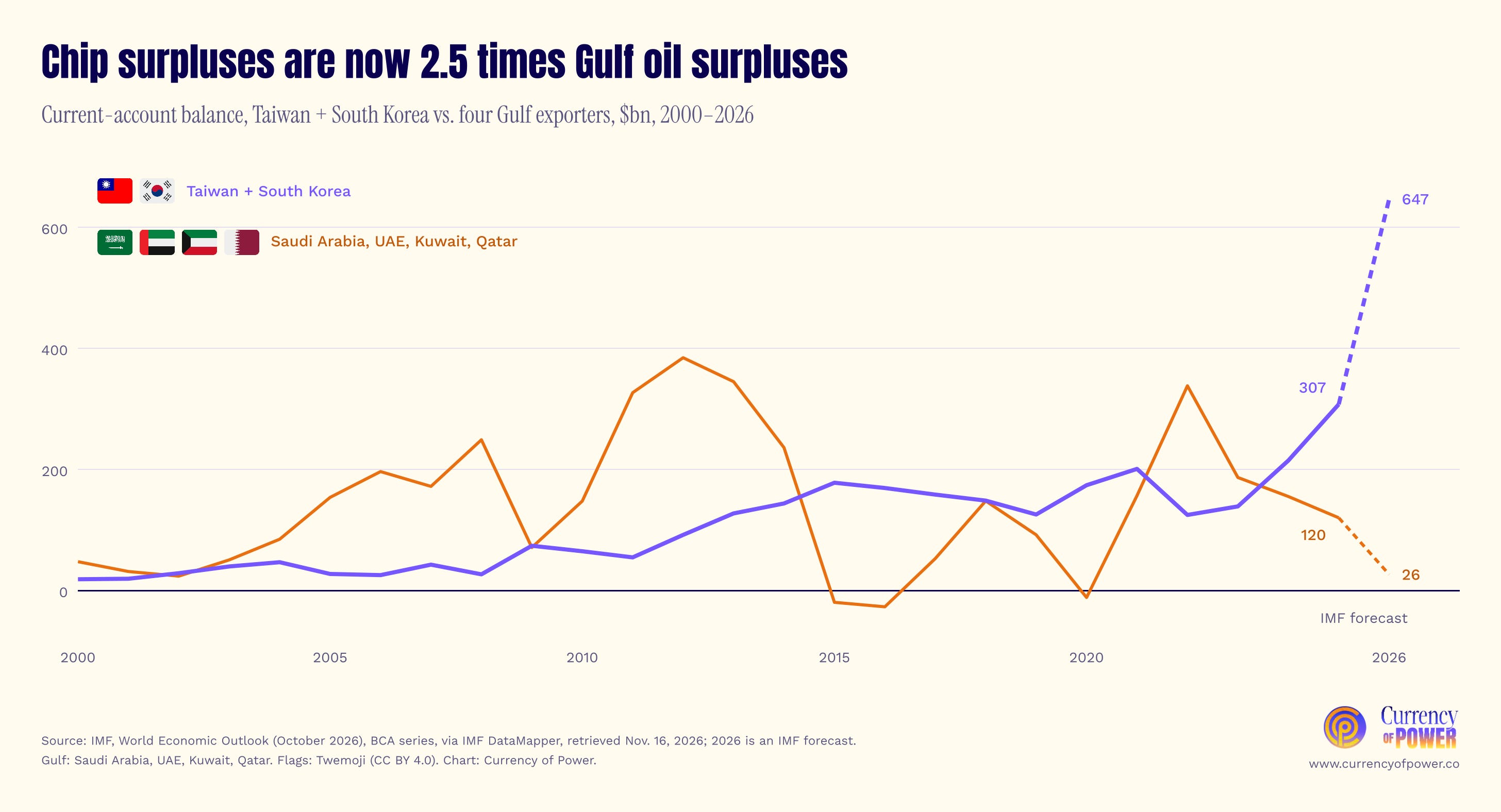
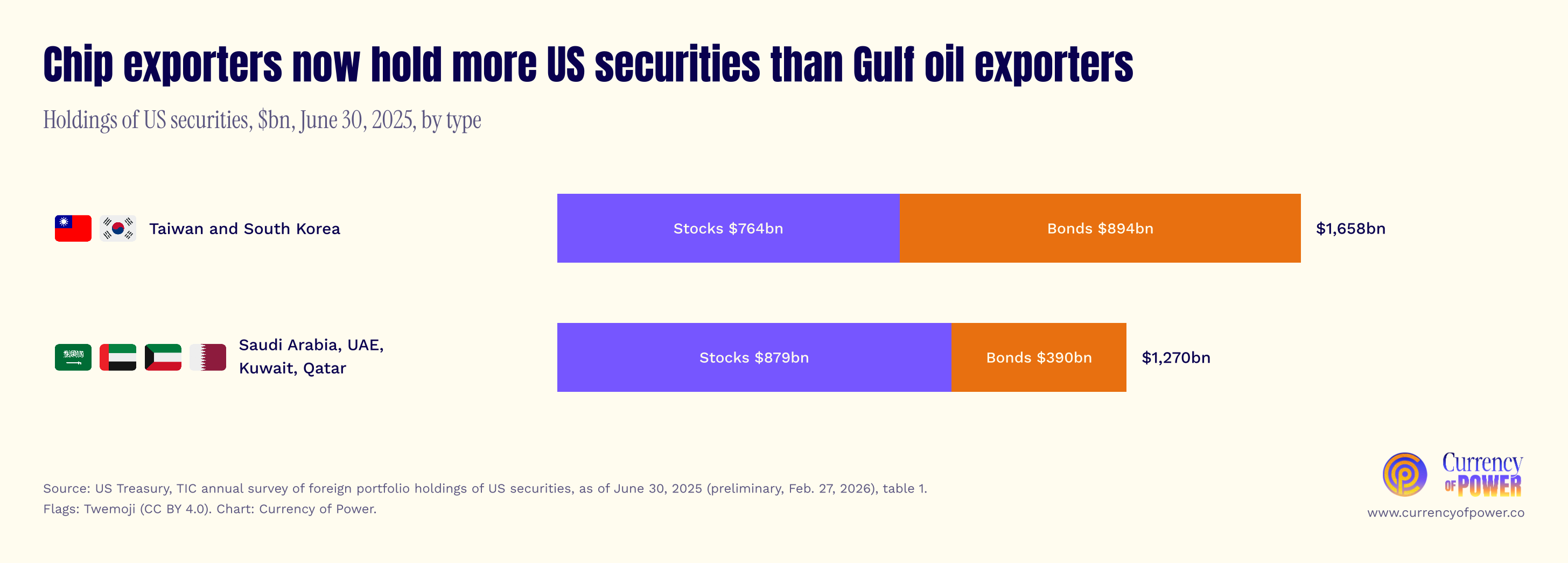
Probably not by coincidence, chip exporters are now also larger investors in the US. In June 2025, Taiwan and South Korea held $1,658bn of US securities, against $1,270bn for the four Gulf oil exporters.
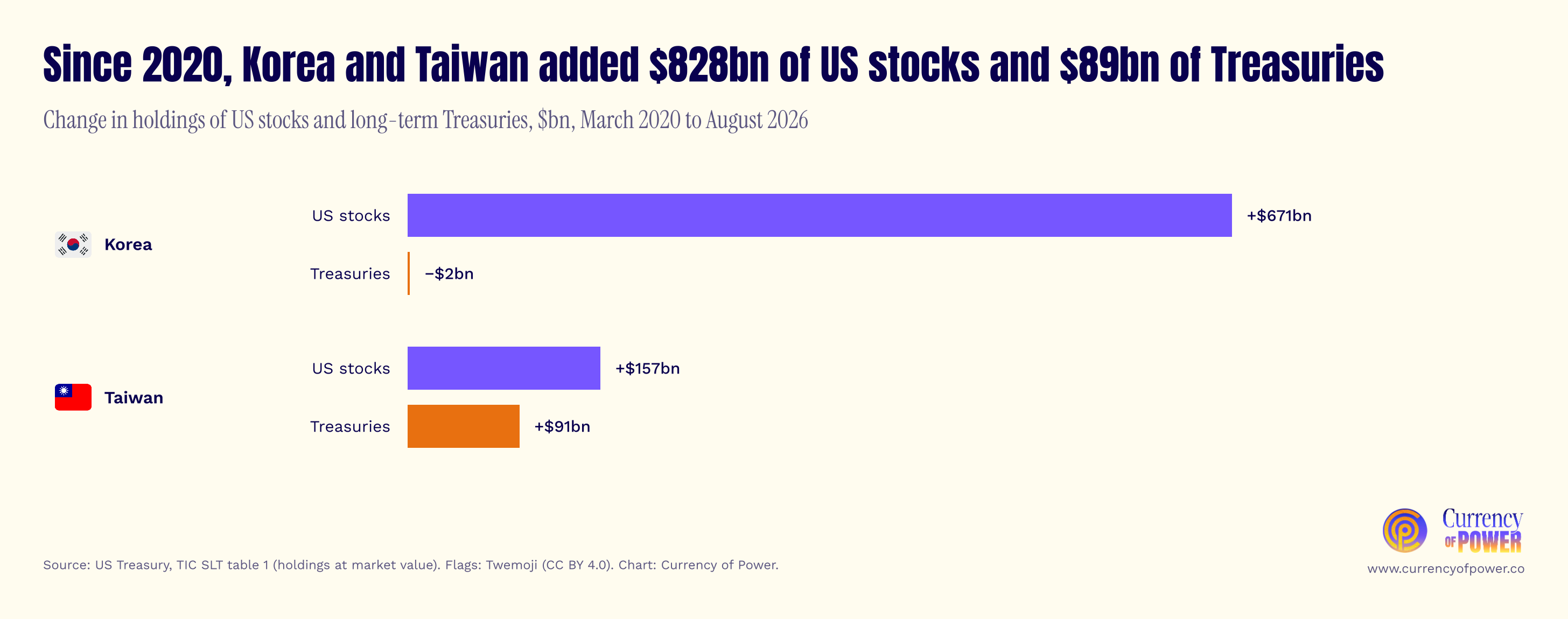
But Taiwan and South Korea do not invest the way oil exporters did. The petrodollars of the past mostly went into US government bonds. By contrast, chipdollars today go mostly into US stocks, including the AI companies that buy the chips. Since March 2020, Korea and Taiwan have added $828bn of US stocks to their holdings and only $89bn of long-term Treasuries. Korean households lead this move: 90% of their foreign stocks are US stocks.
This changes the nature of the support the dollar gets. Foreign purchases of US stocks are now the main way the US finances its current-account deficit, and most of this money comes from Asian chip surpluses. And there’s a big difference in volatility: bond prices move little, but stock prices move a lot. While the petrodollar supported a stable market, the chipdollar supports a market that changes with every earnings report and posts going viral on X. As long as the AI boom lasts, chipdollars keep flowing. But if it stops, this money stops too, and nothing is ready to replace it yet.
🏭 From chips to compute: data centers and the computedollar
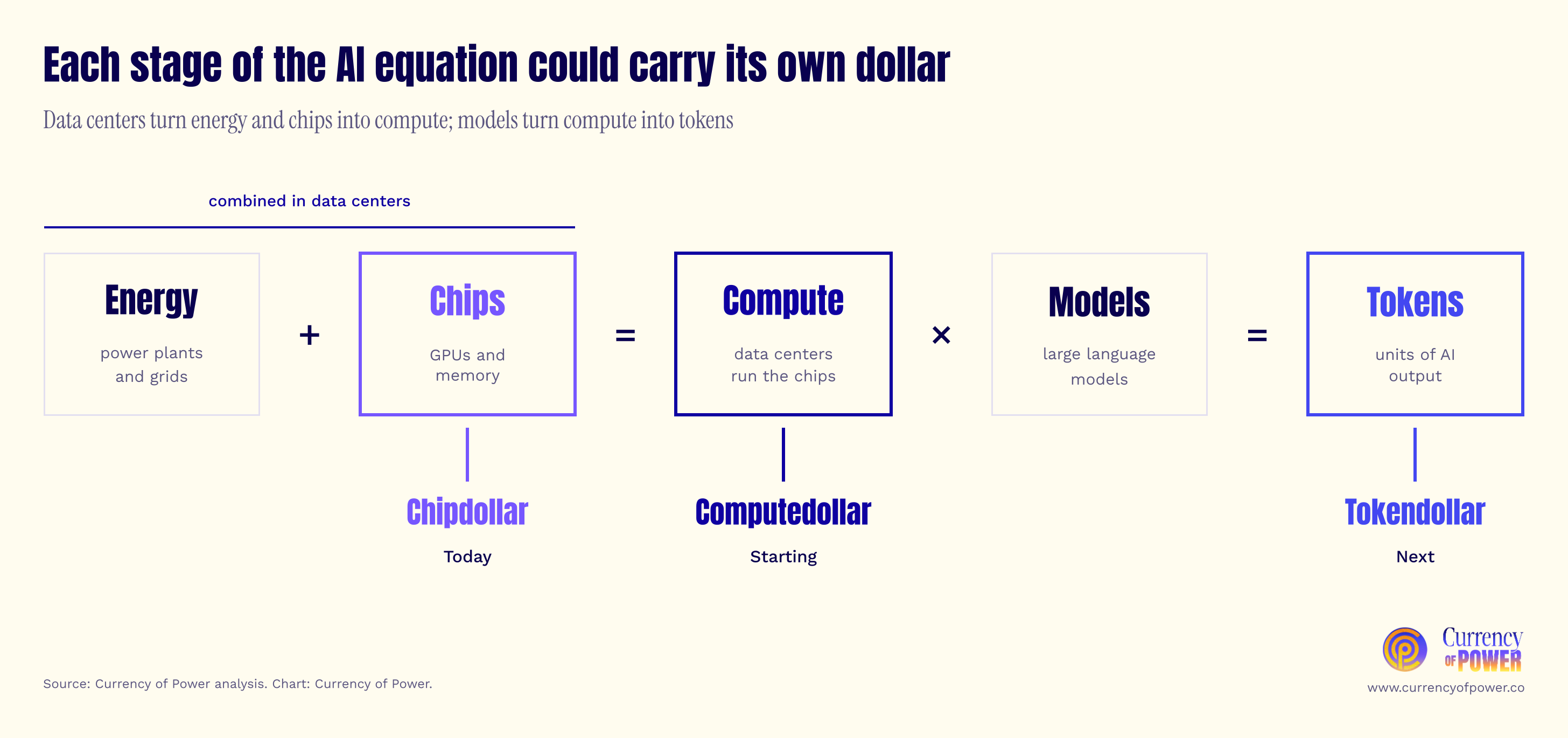
Chips do nothing on their own. A data center combines two inputs, electricity and chips, and turns them into computing power. Models then turn this computing power into tokens, the units of AI output.
We can write it as equations:
Energy + Chips = Compute
Compute × Models = Tokens.
Each stage of this equation carries its own dollar. Chipdollars pay for the chips: this is the only stage at full scale today. Computedollars pay for computing power, but they’re only starting. And then, token dollars could come next.
Computing power already trades like a commodity. Silicon Data publishes a daily price for renting Nvidia chips, with futures on this price set to start trading in New York in October. In August, the CFTC, the US regulator of commodity markets, asked for comments on derivatives linked to computing power, with its chairman describing compute as perhaps the most important commodity of the AI economy. Stablecoins, the settlement rail we expected computedollars to use, passed $300bn this year, from $4bn in 2019. Tether, the largest issuer, now holds so many Treasury bills that it is one of the largest foreign buyers of US government debt.
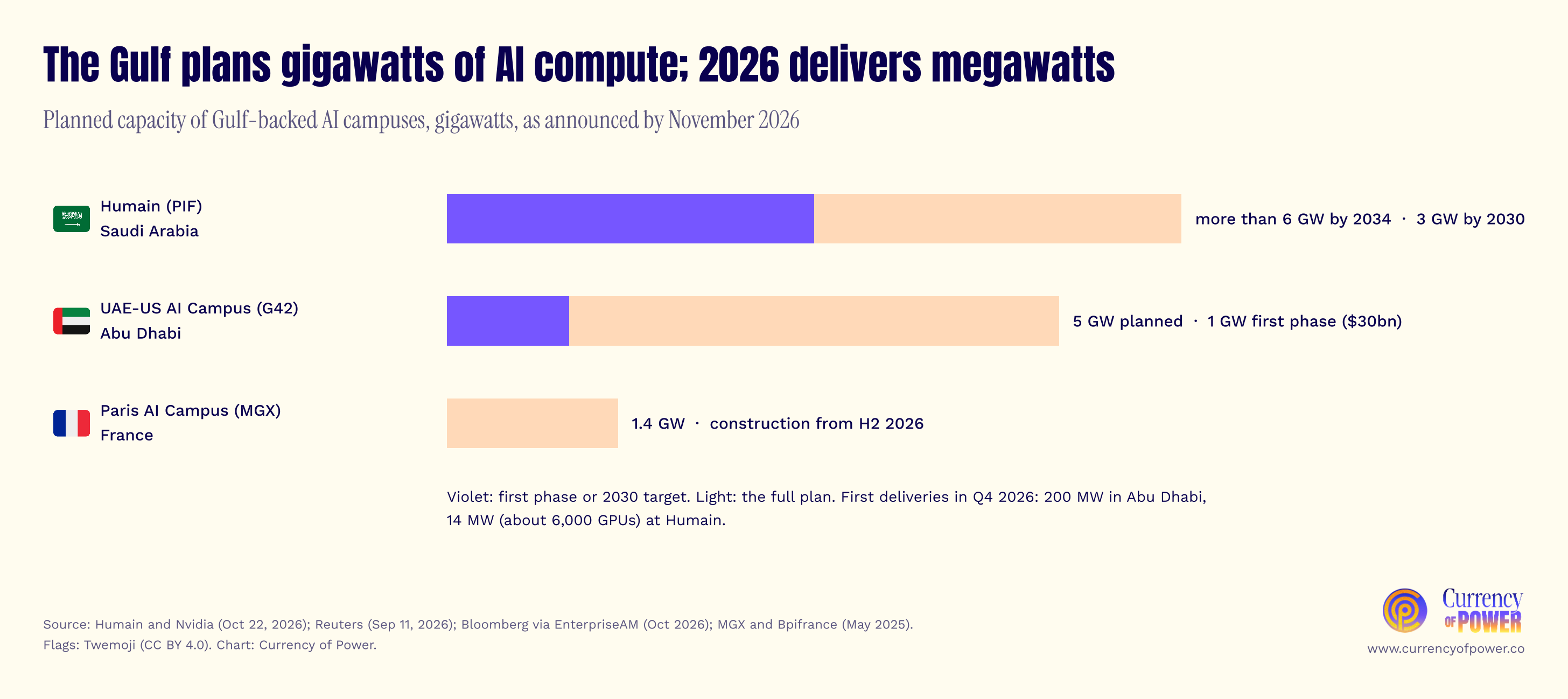
What computedollars still need is scale: many more data centers that sell computing power to outside customers. Gulf states were planning to build them. Before the war against Iran, Gulf states announced more than $300bn of investment in data centers, chips, and AI infrastructure, with partners such as Nvidia, OpenAI, Microsoft, and Oracle. These plans add up to gigawatts; however, what is actually running in 2026, given the geopolitical context, is only counted in megawatts. Until this gap closes, computedollars remain too small to support the dollar; chipdollars have to do the job.