



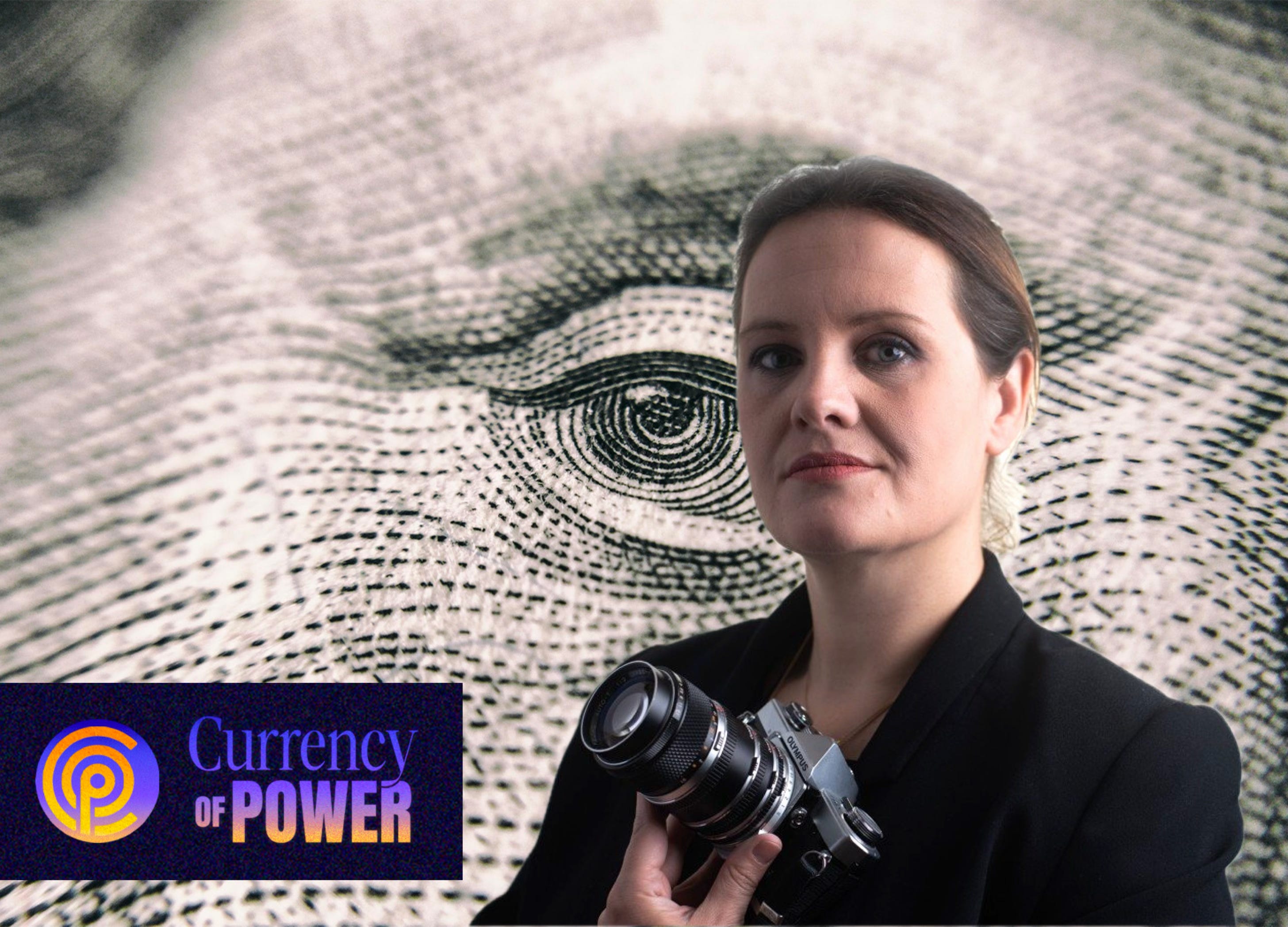
Izabella Kaminska has spent most of her career following a dollar that nobody in authority wanted to talk about.
She started as a general finance journalist — Reuters, CNBC, small English-language papers in the Caspian — before reaching Alphaville, the Financial Times’s blog, where she further developed a long-time interest in the eurodollar: the parallel dollar that circulates offshore, beyond the reach of the Fed, governed by nothing except the confidence of the people holding it.
That interest turned out to be good preparation for 2017, when she became one of the first journalists to argue that Tether was not merely a crypto curiosity but a recognisable monetary form — the latest iteration of something the world had seen before. The eurodollar had been issued by offshore banks in the 1960s on the same basic logic: promise to settle in dollars, manage your liabilities however you like, and hope nobody asks too many questions at once. The crypto crowd did not know what she was talking about. Others, like economist Perry Mehrling, did.
She left the FT to found The Blind Spot, and later The Peg, on the premise that the space between TradFi snobbism and crypto boosterism is where the important questions live — and that covering it honestly requires independence from both sides.
In this conversation, Izabella walks through the origins and logic of the eurodollar, why the LIBOR scandal was widely misunderstood, how the introduction of the euro may have quietly contributed to the subprime crisis, and why she thinks stablecoins are best understood not as a financial innovation but as a stabilisation operation — a controlled way of unwinding an asymmetry that has been building for thirty years. She also makes the case for Tether as a grey-zone instrument of US statecraft, discusses the parallel between the City of London’s offshore role in the 1960s and Tether’s position today, and explains what Poland’s gold purchases tell you about where monetary sovereignty is heading.
She’s active on X at @izakaminska, and you can find her work at both The Peg and The Blind Spot on Substack.

“My ambition is to tell the story of how the monetary system is changing.”
Nicolas: Hello, I’m Nicolas Colin, co-host of the Currency of Power podcast with my colleague Marieke Flament. Today we have a very special guest, Izabella Kaminska, founder and editor of The Peg and The Blind Spot, and formerly editor of the Financial Times blog Alphaville.
Izabella, maybe we’ll start with a quick conversation about your journey from the Financial Times to your current work, and then dig deeper into The Peg and its coverage of stablecoins, crypto, and the new monetary order. It’s a very similar topic to the one we cover at Currency of Power, and we launched at about the same time. It appears we had the same idea simultaneously — that it’s an important topic and deserves more coverage. So thank you very much for being here. Tell us a bit about your journey from mainstream financial journalism to where you are today.
Izabella: Thank you very much for having me. It’s a real pleasure. It was a real delight discovering fellow stablecoin enthusiasts coming at it from the monetary order perspective. I think it’s like Marconi and Bell — we had the same idea at the same time, because it really is a good one: that this needs discussion, not just from a purely technical and industry perspective, but from the bigger global picture of what’s going on. Or as I like to put it, breaking the stablecoin down to its fundamentals in terms of the new monetary order that is emerging.
How I got here: I’ve been a journalist all my life, and I think that’s the point of differentiation between us — I come at it from a journalistic point of view. I’ve always been a finance or business journalist, with a long career spanning Reuters, CNBC, small English-language newspapers in the Caspian, and in Poland as well, because I’m Polish. My parents are Polish. I was born in the UK, but I’m very much brought up in the cultural Polish way.
I got to the point where I was at Alphaville at the FT, and to be frank, Alphaville was one of the best jobs I’ve ever had. I was surrounded by incredibly smart people having very interesting discussions all the time. But the reason I left the FT — and I’ve been upfront about this — is that everything was getting politicized. I don’t think it’s the FT‘s fault. It just became more and more difficult to write about the intersection we’re talking about now. I feel like you have to be independent to do this objectively, because you’re always upsetting somebody otherwise. Finance journalism used to be compartmentalized in a sort of safe space. It didn’t really crash into politics that often. Obviously there was the Great Financial Crisis (GFC), and that was highly political, but even so it was a different type of politicization. Having covered Poland, and as the West became more polarized, it became more difficult to write about these things, at least at the FT in some respects.
I always say this and I do mean it: it’s still a great resource and there are people there who do great work. But journalists in mainstream frameworks are sometimes a little constrained in what they can say. So I was really looking forward to saying my own thing, which is why I left and founded The Blind Spot — the idea being a sort of off-balance-sheet Alphaville, where we could once again go wherever we wanted. It veers more into the politics side, because one of the things about being in an institution is that if you start writing about any political figure — Boris Johnson, Brexit, whoever — you collide with the political teams. There’s a clash over who has more authority to say things, and if you say something different to the others, it becomes cumbersome and politically sensitive.
I thought finance needed a dispassionate assessment from other perspectives — not necessarily endorsing those perspectives, but putting them out there. Investors cannot afford to be politicized. You have to look beyond the noise and the emotionally charged coverage. That was the idea behind The Blind Spot.
Being an entrepreneur is really, really difficult, and I made a lot of rookie mistakes. I also had no funding. As a journalist, I’m incredibly bad at asking people for money — it’s not something I’m used to. Getting funding is very difficult when you’re trying to be objective and neutral and have no paymasters. I tried to do too much too quickly, ran out of money, and had to take another job at Politico. I kept The Blind Spot going alongside that, but it proved conflicting in the end.
I’m now on my second run, having learned the lessons of that period. I’ve realized that for monetisation purposes — and there’s a reason Alphaville was always outside the paywall — monetising that sort of broad, off-the-cuff, speak-truth-to-power journalism is really difficult. You need at least a two-sided market, I think is the technical term.
So the idea with The Peg — I’m still doing The Blind Spot, but my ambition, if the monetary gods shine on me, is that The Peg will become a proper institutional industry offering, at a rate that pays for itself and for really solid, neutral journalism. That’s the key point. I personally believe this space is a little crowded with people either from the crypto side of the spectrum — which doesn’t necessarily provide neutral coverage, and I’m not dismissing them because a lot of those outlets do a great job tracking what’s going on, but they sometimes lack expertise on the TradFi side — and on the TradFi side, there’s still a degree of snobbism about the other side. Central banks are moving slowly towards understanding the nitty-gritty, but there is still a somewhat dismissive attitude towards new ideas within that community. That included me, many years ago. I’ve come more to the middle.
My ambition with The Peg is to frame everything in the very big picture — the macro story of how the monetary system is changing. If that succeeds and I can get proper journalists to support me and it pays for itself, then the creative Alphaville-style content can be put out for free as reach, with The Blind Spot remaining as a free offering. That’s the vision. Whether the gods allow me to follow through is another matter.
Marieke: I think it’s really interesting what you say, because independence in that sector is very difficult. With crypto outlets, if you have sponsorship, you feel an obligation to certain protocols. It’s hard to strike the right balance. But the gap you’re describing — bridging this dialogue in a different way — is clearly what’s missing.
Izabella: I can but try. And I do think the space needs a strong-minded, independent voice with journalistic pedigree.
“A eurodollar is a parallel dollar – a liability issued by an offshore bank that promised to settle in dollars if and when redeemed in the US.”
Nicolas: We wanted to start the conversation with eurodollars, because that’s a very old and largely overlooked segment of global finance that in many respects is a precursor to today’s stablecoins. A lot of people interested in stablecoins come from the crypto space and, like everyone in tech, don’t know much about history and aren’t particularly interested in it. What we try to do every time we write about these topics is rewind and remind people that these things aren’t completely new. Eurodollars are, again, a precursor to stablecoins. Can you tell us the history of eurodollars and why you got interested in them?
Izabella: It is a mystery even to myself. I just found the whole thing so fascinating. I got into it when I was at Alphaville, but I think if I was to really think about it, the reason I’m so drawn to eurodollars is because I’m Polish, and I saw the sharp end of the eurodollar market in the former communist system — where those dollars were circulating, not just in terms of the high-value corporate financing that the City of London was doing, but on the grubbier side: the kantors, the underground exchange. Not quite illicit, but informal.
I have a personal connection because my father was a money transmitter in those days. He was based in London and had one of the three main money transmitters doing hard currency transfers to Poland — and was somehow involved in two of them. It’s all very murky. I still can’t get a straight story from him about how it worked. I used to work weekends at his office, which doubled up as a travel agency and a parcel company, because that’s what you did — sending parcels and money transfers. I would spend my Saturdays after Polish school helping him file accounts, just organizing the cabinets without really knowing what I was doing. But now I realize what was happening: we would take the payment slips and stand outside the Allied Irish Banks and pay them all in. It was always the Allied Irish Banks, and now I realize that’s because the Irish had a different jurisdictional approach to transfers in that era — they were kind of neutral politically, which is why it enabled that. All these things started coming together.
Then separately, I was fascinated by this idea of a parallel dollar circulating through Europe. I think the second part of my fascination came when I was at Reuters as a graduate trainee, doing some time on the eurobond desk. I couldn’t understand the difference between a conventional bond and a eurobond, and I don’t think a lot of the reporters covering that market understood it either. Nobody ever properly explained it to me. That was the moment I thought, I’ve got to understand why this is a different thing. So I went off on a quest to the British Library, got hold of historic editions of Euromoney, and went through them trying to work it out.
By the time I was at the FT, eurodollars had become so second nature that nobody really questioned the difference. Even during the GFC, I think, nobody really put two and two together that the LIBOR crisis was fundamentally a eurodollar crisis. And ever since then, I’ve just been trying to get more and more insight. By 2017, when I spotted stablecoins, I was one of the first people to make that connection. I put out a story saying Tether is the new eurodollars, and at the time I don’t think anyone in the crypto space knew what I was talking about. I was at a gathering with Perry Mehrling, who I absolutely adore, and we were discussing it on the sidelines. He agreed they were eurodollars. The rest, as they say, is history.
Nicolas: What’s the short definition of a eurodollar? It’s a dollar that never goes back to the US?
Izabella: Yes — it’s a parallel dollar. These days it’s heavily regulated, so slightly different. But back in the old days, it was effectively a liability issued by an offshore bank that promised to settle in dollars if and when redeemed in the US. You could get physical cash dollars — Soviet-style kantor — or you could get a correspondent in America to pay out to another American bank. But how those banks managed their liabilities was up to them and completely unregulated. The US couldn’t really control it, and that’s where a lot of the risk came from, because these eurodollar banks were effectively issuing cheques their books sometimes couldn’t cash.
The Americans weren’t very happy about it, but they were also, unwittingly, the creators of the eurodollar market — because it was their own regulatory climate, which capped domestic interest rates, that made it so lucrative and viable to lend into the offshore market overnight. That provided the liquidity and funding that allowed the whole thing to expand.
It most famously started in the 1960s. A lot of these dollars ended up outside the system to pay for things — the famous origin myth involves Vietnam and the dollars funding various activities in the Soviet Union, and then of course the petrodollar, which ended up banked in European banks in Switzerland. That created a nice source of perpetual dollar flows that could be re-lent almost on their own parallel ledger.
Nicolas: A characteristic of the 1960s was the fixed exchange rate system. Why were counterparties outside the US using dollars instead of francs or Deutsche Marks?
Izabella: One of the main reasons was liquidity. Having to change money between the Deutsche Mark and the drachma — there simply wasn’t enough liquidity. The dollar became a bridging currency in many cases. That bridging role created a float, and that float paid a good interest rate in Europe if you funded it overnight. That’s really how it originates. It was to do with the fragmentation between all these different currencies.
By the time of the GFC, London had become the hub of eurodollar trading. It owned that market. By that point we were on floating rates, and it was in some ways the market price for dollars as opposed to the administered price through the Fed. When we saw LIBOR breaking, one of the issues was that it was a market-based price, which is very hard for central banks to influence. Post-GFC, a lot of the regulatory action has been focused on bringing that market rate under control of the Fed — done by dropping LIBOR and pushing everything onto a collateralized rate, which poses its own problems, but that’s a different conversation.
Nicolas: Can you explain what LIBOR is and what happened with it?
Izabella: LIBOR is the London Interbank Offered Rate. What’s really interesting is that crypto markets have started to evolve their own equivalent. The way I like to describe it is that it’s the rate you’re prepared to pay for dollars in order to avoid going to the central bank. Because it’s a hypothetical, it was notoriously difficult to index. It was almost theoretical — like an insurance rate. If I were to have to borrow from counterparts to avoid going to the central bank, what would that rate be? That posed its own issues, which obviously led to the LIBOR scandals, although post-GFC I think the story we heard about LIBOR was subject to some hysteria and a real quest to find a scapegoat.
Having met Tom Hayes, one of the bankers arrested for manipulating LIBOR — I interviewed him a couple of years ago, and he’s since been acquitted — I think a lot of the judicial cases failed to understand how this market really worked. Everyday people just wanted to see a banker go to jail. There was a very big difference between the manipulation of LIBOR for commercial interest and what was later argued — that the Bank of England itself was guiding LIBOR down and telling banks to give inorganic rates. So who was really manipulating whom is the question. I don’t think it was as clear-cut as it was portrayed at the time, and a lot of traders who probably didn’t deserve to go to prison did go to prison.
But LIBOR was, in a way, the market organically creating a price of money outside the domain of the central bank’s administered rate. Which is why when the Bank of England wanted to guide it lower, it was forced to literally phone up the CEOs and say it would really appreciate it if they did — because they had no direct control beyond whatever diplomatic channels they could deploy.
Nicolas: So it’s another way in which eurodollars are precursors to stablecoins — there’s that same defiance towards central banks.
Izabella: When there’s a liquidity issue, the idea is that there is a price of money amongst counterparties. Say hypothetically a stablecoin is short of the liquidity to pay out for redemptions — it’s the equivalent of going to fellow stablecoin providers who might have excess and asking them to lend overnight. The counterparties then determine whether it’s a good loan. In the GFC, what happened is that everyone knew there was a de facto shortfall in the whole ecosystem. Like a game of musical chairs, one chair was missing and the banks all knew it. So nobody was prepared to lend to anyone because you might be caught without the chair. That’s why you had to have central bank intervention.
Nicolas: Did the introduction of the euro have an impact on eurodollars?
Izabella: It’s an interesting question. I’m confident I read a BIS paper on this many years ago by Patrick McGuire, building on work by Robert McCauley. The general premise, as I recall, was that the introduction of the euro was one of the catalysts for subprime, because it created a need for that float to go somewhere else. Suddenly you had all this liquidity looking for higher rates, which had been used to collecting a nice return from funding FX flows in Europe, and suddenly it needed to go somewhere else. That cheap pool of liquidity helped fund looser borrowing standards elsewhere. I don’t want to misquote it or inaccurately attribute it — I read this ten years ago — but that was the premise.
Nicolas: That’s interesting. It implies that if dollar-denominated stablecoins grow in volume, and then someone manages to launch a euro stablecoin that grows as well, there’ll be a float looking for new destinations, and that could potentially trigger the next financial crisis.
Izabella: Well, I think the difference is that at the moment stablecoins are mostly dollar-denominated, servicing either emerging markets with a lot of FX volatility, or DeFi and crypto markets generally, which are cross-border and everywhere. That makes it slightly different, because there isn’t a natural organic process by which all these nation states are going to come together and create a comparable rail system across all those different jurisdictions. It would involve a massive cross-border currency project — something like a single currency project between all these emerging markets — which I just don’t think is going to happen. It would be interesting if the euro displaced the dollar through market dynamics alone, but it would be a market-led phenomenon rather than a political one like the creation of the euro itself.
“Dollarization is a type of geopolitical statecraft. You get hooked on us, and we come and rescue you.”
Marieke: Hearing about eurodollars through the lens of what you saw in Poland makes me think of the fear of dollarization today — how the dollar perpetuates itself and becomes embedded in economies. Is there a threat of dollarization from stablecoins that is bigger than it was with the eurodollar?
Izabella: I think there is a threat of dollarization. I actually think it’s part of the Doge-style doctrine mentality, and I think it’s a type of geopolitical statecraft. It’s not unique to the US — it’s very similar to how the EU operates with the euro system, where the euro is a sort of carrot for membership and expansion. Come join, assent to our values and standards, and one day you get to be part of the euro, your government gets to benefit from common mutual borrowing costs. Bulgaria has most recently joined the euro, and that’s very much the draw — you come from a currency board regime and get to borrow at the euro system rate rather than your national rate. That’s the carrot for expanding geopolitical influence.
I think the US is doing something very similar, but not through a formal accession process. It’s just saying: if you’re in our sphere of influence, have an unreliable currency, and we’re going to unofficially encourage dollarization — then you get hooked on us and we come and rescue you. A great example is Argentina. You saw last year when the US came in to stabilize the currency using the Exchange Stabilization Fund. Scott Bessent actually made money on that trade in the end. It shows how much political influence that provides. Further down the line, it creates a political onboarding pathway for countries like Argentina to be part of greater America effectively.
There are great advantages to being in the dollar system. For countries facing the choice between that and the BRICS orbit, the US pushes a tough AML/KYC regime through the FATF with one hand, while with the other it’s quite happy to spread the dollar around. That was the case in the Soviet Union. Officially there were capital controls and no real correspondent banking. But behind the scenes, it suited American interests for black markets to be priced in dollars, because that created price discovery and exposed the degree to which the planned economies were being mismanaged. It was a great advertisement for the stability of the dollar in relative terms.
“Saudi Arabia was the central bank of oil. China replaced it with what I call the sweat dollar.”
Marieke: Maybe we can link this to Bretton Woods, the petrodollar, and what happened post-Nixon in 1971. How do you tell that story?
Izabella: Russell Napier, and I think it might actually have been Paul Volcker who coined this, describes what we moved to as a non-system. Nixon famously took the dollar off gold, largely because of the French, and everyone thought it would be the end. But the story of post-1970s dollar markets is that they went from strength to strength, partly because it really fuelled the eurodollar markets. Once the dollar was unlinked from gold, there was really no holding back, and endogenous money creation became a massive phenomenon, mostly in the offshore world.
Geopolitically, right up until the 90s, you had the Cold War and this incredible competition between two systems. Through its unshackling from gold, the dollar became effectively a borderless currency with mobility beyond any other. I think the dollar became what it was partly because in beauty-contest terms it was being circulated so heavily in the command economies, which were mismanaging their own systems. That was really the making of the dollar.
In Europe, from a corporate financing perspective, European corporates were the most intensive issuers of dollar-backed bonds. It was also the era of bearer bonds. It was a unique time where US statecraft — selling Americanism abroad, liberalisation everywhere — created a slight tension between external and domestic policy. On one hand, control the system; on the other, be quite pleased to see the dollar circulating everywhere.
That culminates around the 90s, where you get a series of successive little crises — savings and loans, and others — and then increasingly systemic-style events. The key point for the dollar is when China starts to engage, but first it’s Japan, because of Japan’s industrial policy. And then of course the petrostates. The petrodollar, the Soviet Union, Japan’s industrial policy, and then eventually the Chinese export model — those are the pillars.
Nicolas: A lot of people are rediscovering petrodollars because suddenly the whole system seems to be changing fast — partly because of conflict in the region, but also because the US is now energy independent.
Izabella: That petrodollar regime starts coming to a head in 2014, when you see the rise of shale. It’s not a coincidence that as the US becomes more independent, you see political change in Saudi Arabia — it’s necessarily having to woo and sell more to Asia and China, which changes the game quite fundamentally. This culminates in the displacement of the old regime with MBS, who comes to power realizing that the days of bottomless petrodollar funds are at least changing, if not diminishing. He’s the one who realizes Saudi Arabia has to look beyond petrodollars, and starts the Vision 2030 agenda. We’re still living in the fallout of that regime change.
Nicolas: Why does it change things? We don’t expect Saudi Arabia to stop exporting oil. What you mean is that the buyers over time tend to be less prone to paying in dollars, and therefore Saudi Arabia cannot invest in the US economy and has to reconsider its model?
Izabella: The importance of Saudi Arabia is that it used to set the price of the marginal barrel of oil. That is where its power lay — it was the central bank of oil. For as long as the marginal barrel was effectively priced in dollars, underpinned by a US-Saudi relationship with a codependency, that anchored the dollar in a very specific way and ensured a pipeline of petrodollars and liquidity coming out through that avenue, lubricating all the eurodollars in Europe.
What has happened from the 90s and noughties onwards is that the main importer of external dollars becomes China. And it does that not through exporting a raw commodity like oil, but through what I call the sweat dollar — effectively, sweatshops and very cheap labor undercutting manufacturers in the West. That’s a completely different model, and ironically it still needs to be funded by oil from Saudi Arabia.
So you end up with a different regime. As the US’s dependency on Saudi Arabia goes down, its dependency on China goes up — which is where you get to the crunch point with Trump and tariffs. The US realizes it may have shed its dependency on a controlled ally and replaced it with a dependency on imports of manufactured goods that are actually essential to maintaining national security, armed forces, and technological advantage. That was never the case with Saudi Arabia. The deal there was: we buy your oil, you pay for it in dollars, you use those dollars to buy our defense systems, and we stay on top.
The China deal is very different. China is accepting dollars but not reinvesting them by buying US arms. It’s investing them in US debt, making it incredibly expensive for America to maintain its advantage. Then reinvesting the proceeds into its own domestic military force — outside the US security umbrella — which poses risks the old Saudi relationship never did. The exorbitant privilege becomes an exorbitant burden: the US was paying a coupon to China, which got reinvested into a military force not aligned with it.
“The exorbitant privilege becomes an exorbitant burden: you end up paying a coupon to China, which gets reinvested into a military force not aligned with you.”
Listen to this episode with a 7-day free trial
Subscribe to Currency of Power to listen to this post and get 7 days of free access to the full post archives.


