



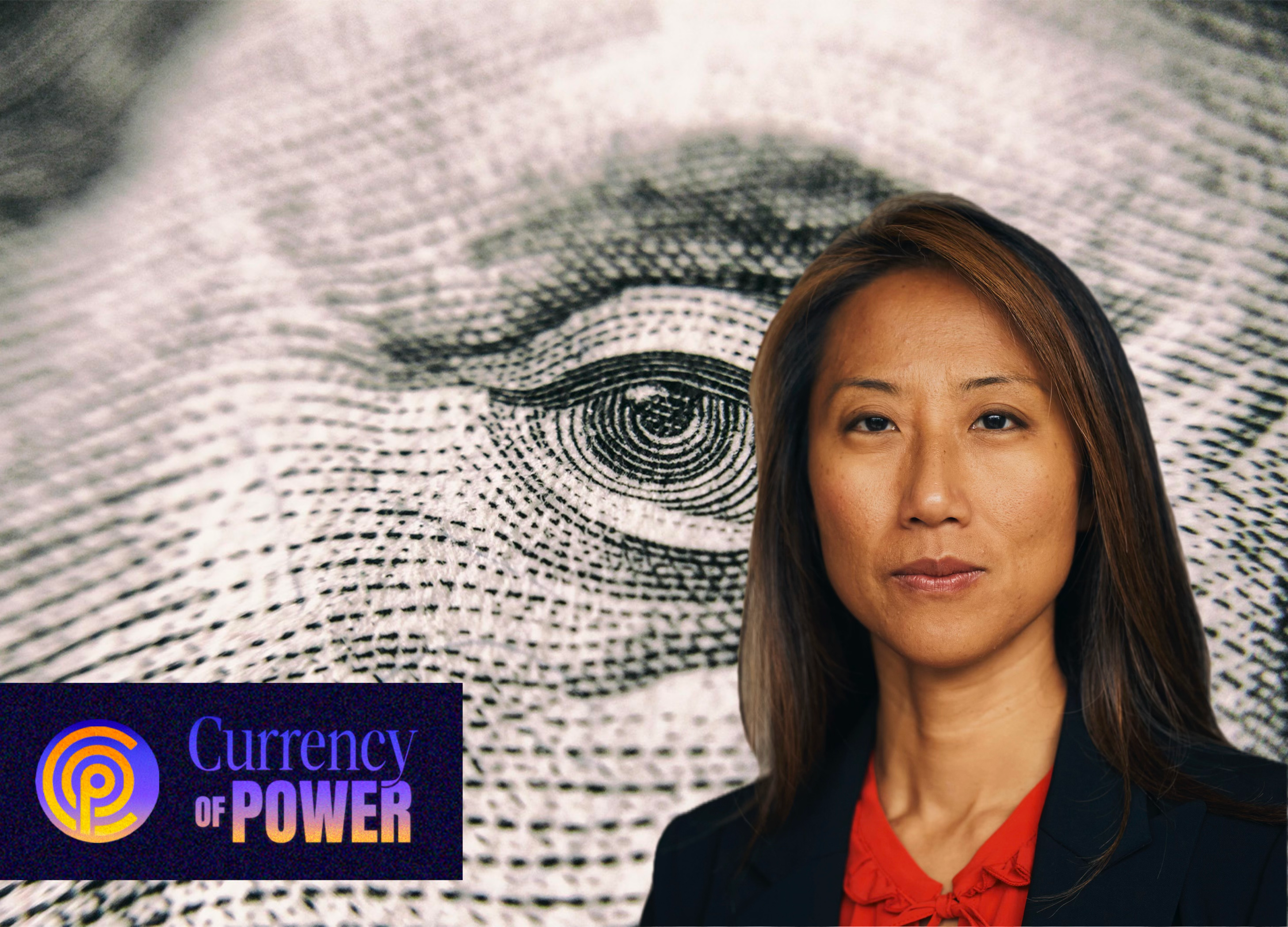
Since 2012, Yanmei Xie has studied China’s political economy and its rivalry with the West. She began at the International Crisis Group, where she became senior China analyst and acting director of its China project. She then joined Gavekal Research as a geopolitics analyst, where her forecasts informed institutional investors, multinationals and policymakers. Today she is a senior associate fellow at MERICS, the Mercator Institute for China Studies in Berlin, a senior adjunct researcher at the RAND China Research Center, and the 2026 senior TOY fellow at Asia Society Switzerland. Her work covers China’s industrial policy, its technological and industrial competition with the United States, and its trade frictions with Europe.
Yanmei’s central claim is that the West let its industrial base thin out strand by strand, like a sweater, until whole ecosystems were gone. By contrast, China kept its ecosystem, and in a long contest, commercial or military, factories are the reserve capacity that counts. For Europe, which still makes cars and planes, that may be the most urgent warning of all. In this episode, we discuss:
how China built its EV industry with subsidies, protection, fierce domestic competition, and a catfish called Tesla;
why embodied AI may do more for productivity than AI applied to services;
why the car industry doubles as a reserve for wartime production;
why Europe should think twice before giving up on solar panels and batteries;
why a “reverse Deng” is harder than it looks, and why Spain is Europe’s soft underbelly;
why European carmakers are competing with the Chinese state.
We recorded on October 23, 2026. Yanmei sees no global rebalancing coming: China’s trade surplus keeps setting records, and she doubts Europe has the political will or the tools to answer what it calls China Shock 2.0.
Most of Yanmei’s work goes to clients and is not public. Her public writing and talks are on her LinkedIn and at MERICS.

Nicolas: Welcome to the Currency of Power podcast, where we explore how money, technology and geopolitics are reshaping the global order. We speak with the people building, regulating and challenging the new financial infrastructure, from currencies and stablecoins to AI, trade, energy and the competition for technological power. Our goal is to understand how the financial system is changing and who gains influence as it does. I am Nicolas Colin.
Marieke: And I am Marieke Flament.
Nicolas: And today our guest is Yanmei Xie. Yanmei, you’re a senior associate fellow at MERICS, the Mercator Institute for China Studies in Berlin. You work on China’s political economy, its industrial policy and its competition with the US and Europe. You were previously the China policy and geopolitics analyst at Gavekal Research, and before that, you led China work at the International Crisis Group. You also once covered US politics as a journalist in Washington, which in a way is very timely these days. Your essays have appeared in the Financial Times, the Wall Street Journal and Foreign Policy.
Yanmei, welcome to Currency of Power.
Yanmei: Thank you for having me. Very happy to join.
Nicolas: So Yanmei, as we were discussing before we started recording, we have a few connections in common, as I know several people who work or used to work at Gavekal. But I discovered your work, I think last year, reading a LinkedIn post of yours dedicated to manufacturing. It explained in the most illuminating terms why manufacturing is important for a nation, and why you can’t really afford to build your entire economy on intangible stuff like services, IP, software and things like that.
I was very interested in that. It was a major contribution for me, because my background is that I spent about 15 years in the tech startup world, which was all about software. There was this idea from Marc Andreessen that software would eat the world and all the rest didn’t really matter. We were all brainwashed by that. And we had to wake up, sometime between 2022 and 2025, to the fact that tangible things matter, that we in the West struggle to build them, that China, by contrast, is excelling at building them, and that maybe there’s something we should look into here.
So I hope this conversation today will help us understand a bit more about this contrast between manufacturing and services: why manufacturing matters, what China has to teach us in that regard, and what Europe and the US can do on that front.
Maybe we’ll start with the first topic, which is the difference between manufacturing and services. I think the three of us grew up in a world where the West, especially the US, was massively outsourcing its manufacturing capacity to the rest of the world, notably China. Marieke and I are French, and a very major French company back in the day was Alcatel, an equipment manufacturer for telecommunication networks. The Alcatel CEO at the time had this idea that Alcatel could become a fabless company: that they didn’t need to have any factories and could focus on managing the lab and managing everything that was intangible. That felt like a sustainable path back in the 1990s. Some 25 years later, it doesn’t really look sustainable anymore. So can you explain why? What’s wrong with the idea that a country can live on software, finance and services?
Yanmei: So first, let me pick up on your theme of the changing of the times. I also grew up and was educated on liberal economics: this idea that global allocation of resources was the most efficient, that countries should follow the principle of comparative advantage, and that everybody would be better off from that.
For a long time, the US economy and the Chinese economy lived in nearly perfect symbiosis. The US was great at everything virtual. You had the barbell economy: Wall Street on the east coast and Silicon Valley on the west coast producing software. And it also happens that Wall Street loves software, because it doesn’t require a whole lot of upfront capital investment, and the returns can be very fast and exponential. China, meanwhile, didn’t mind and was good at making hardware. It didn’t mind the grunt work of making things, often with lots of investment and very thin margins. The two countries seemed perfectly complementary.
But we woke up one day with Trump launching the trade war on China, and it seemed that the world, particularly the US, had to rethink this arrangement. I think the rethinking started well before the first Trump administration and the first trade war, though. It came from the economic, societal, political, and security consequences of this kind of unbridled globalization. Let’s pick them off one by one.
Economically, there was the discovery that the software and virtual economy were perhaps great at financial returns, but a lot of the productivity growth still came from manufacturing, from the making of hardware. Take the service economy, especially the high-end service economy: doctors and lawyers. There are only so many hours in their day. So the amount of work you can squeeze out of each individual to increase productivity is limited, even when combined with software. Technological upgrading in manufacturing, by contrast, can spark exponential growth. If you equip a worker with robotics and automation, productivity growth can be exponential. Manufacturing is also more conducive to exports. It’s easier to ship and export goods than services, especially services tied to people. So that’s the economic front.
Then on the social consequences: manufacturing is still, in many places, the backbone of the middle class. Services, on the other hand, tend to produce a more bifurcated, more extreme economy. On one end you have the very highly paid service professionals in banking, health care, and the legal profession. On the other end you have retail and restaurants. Services tend to have these two extremes. The resulting income and wealth inequality can have destabilizing social and political consequences. Arguably, the rise of populism we’re seeing across Western economies is in part connected to that.
I’d also point out that the high-end service professions, like consulting, banking, and law, require people to be able to talk, look, and dress smart. It also helps to already have networks. Say you’re a Brit who graduated from Oxford: you can speak the professional language, appear smart, and come with either family networks or the networks you built at one of these elite schools. It’s much easier for you to break in. For a kid from a working-class family, it’s much harder to rise to the middle class or the elite through that path. Manufacturing, comparatively, is a more available and tenable path for people from that background.
And then there are the security consequences, but I’ve talked long enough, so perhaps we can leave that for a bit later.
“In China they call it 实体经济, the ‘real economy’.”
Nicolas: What you just said immediately raises two objections, both very timely.
The first is about AI. Why would you say that if we apply AI to services, we can’t grow as exponentially as in manufacturing? And by the way, I’d be interested to hear more about the idea that manufacturing can grow exponentially. If you could explain the levers a manufacturer can pull to unlock that exponential growth, I think it would make it easier for people to understand what manufacturing is really about and what really determines growth in that sector. So the first objection is what we hear in Silicon Valley: the exponential growth we used to enjoy in manufacturing, we will now enjoy in services, because you plug AI into the law firm and suddenly it grows exponentially.
The second objection is this. As you rightfully explained, manufacturing lends itself well to exports. But there are a lot of people in today’s world, including some of our guests on this podcast, who explain that the world suffers from too many exports, and that maybe we should curb exports, especially those coming from China, to make it possible for the world to rebalance. Curbing exports is a high priority at the moment.
So those are my two questions.
Yanmei: Sure. First, I want to qualify my statement. What I’m advocating isn’t a fetishizing of manufacturing. Arguably, that’s what’s happening in China: a kind of worship of manufacturing. What we’re seeing as a result is a glut of manufactured goods, not only in China but also flooding the world. What I’m arguing is that there is perhaps too much manufacturing in China and too little in the West. There needs to be some balance.
You rightfully pointed out that AI might bring a paradigm shift in the potential productivity gains from service economies. Consultants, lawyers, healthcare workers, and even researchers armed with AI are no longer constrained by the hours in their day. I think that’s a very legitimate challenge to what I was saying, and I’m ready to concede that this is a scenario that lets me further qualify my argument.
But also consider the potential of embodied AI: AI that is not confined to the internet but unleashed in the physical world. Factories can actually go dark and, with very little human supervision, run 24/7. Not only that, the AI can continuously optimize the process and gain efficiency. It can continuously optimize the supply chain and optimize inventory versus supply. And we’ve also been talking about humanoid robots. I know that right now they’re far from capable of replacing human workers, but fast forward however many years and perhaps they could. So the productivity gains that could be unlocked by physical, embodied AI could perhaps again outstrip those of purely internet-confined AI working solely in the service economy.
And then your other point, about exports. You said the world has too many exports. This relates to what I was saying earlier about the balance of the global economy. Most of the excess of manufactured goods and exports comes from one origin, which is China. The country does have a policy that privileges manufacturing above all. In China they call it 实体经济 shiti jingji, the “real economy,” which I think is indicative. They consider manufacturing and manufacturing-adjacent sectors as real, and everything else, including finance and software, as less real. The social media and consumer platforms of the world they consider “soft tech,” versus technology that comes from hardware advances, which they call “hardcore tech.” Government policy favors hardcore tech and seeks to constrain the wild growth of soft tech.
So again, what I was advocating was not for everyone to adopt a mercantilist, export-driven economy. China has too much manufacturing; the rest of the world doesn’t have enough, and, as we discussed earlier, there are economic, societal, and political consequences that come from this imbalance.
“Introducing a catfish into the sardine tank”
Marieke: If I may jump in here, Yanmei, because this is super interesting. I’d like to bounce off something you talked about when I met you at the University of Zurich. You were invited to talk about what Europe can learn from Chinese industrial policy, and I thought your talk was brilliant, because you decomposed how the Chinese EV industry had actually come to exist and come to life. I found that example absolutely eye-opening in terms of how the country thinks about industrialization and also how it finances industry to make that happen. I wonder if it’s a good illustration of what you’ve been describing, of China really thinking that hard industry is the way to go. Could you walk us through your decomposition of the EV industry in China, the way it’s financed, and how that fuels the belief that this is the most important thing for the country?
Yanmei: Right. I think the EV industry is a fascinating example and also a very neat showcase of China’s industrial policy. In our lifetime, we grew up with industrial policy as a dirty word, as a Soviet-era kind of thing that liberal democracies should avoid. In the last few years, industrial policy came back into fashion. But I still think Western countries are very out of practice. They have lost the muscles and the state capacity to really implement it.
So, back to Chinese EVs. The Chinese EV policy actually came against the background of a rather failed industrial policy in internal combustion engines. Since the 1980s, China had been trying to build its own indigenous auto industry, starting by inviting foreign companies to come to China and form joint ventures with Chinese companies. The idea was to extract foreign technology and build up Chinese brands. But the Chinese joint venture partners were mostly state-owned enterprises. They were not the most hungry, most driven, or most innovative companies. They were happy to let their Japanese, German, and American JV partners do the design and bring their brand recognition and just take the profit. After 20 to 30 years of this recipe, not a single globally successful Chinese auto brand had emerged from this ecosystem.
So Chinese policymakers decided they wanted to leapfrog the West with EVs. They considered EVs a brand-new blank slate where they could deploy state capacity to leapfrog the incumbents. Chinese industrial policy is often a combination of protection and competition. As always, it started with subsidies: subsidies for battery makers, for EV makers, for consumers who bought EVs, and for companies that built charging stations. But all of them were subtly designed to disqualify foreign producers.
At that time, the Japanese and Korean battery makers, Panasonic, LG, and Samsung, were the global leaders, and all the foreign car brands partnered with them to design their EVs. China had a whitelist of batteries that qualified for subsidies, and, just by coincidence, the only ones that qualified were Chinese battery makers. This had a couple of effects. The Japanese and Koreans were out. I remember the Korean battery makers rushed in to build billion-dollar factories, hoping to catch China’s EV boom, only to find themselves left out in the cold. And the foreign carmakers that had designed their cars around Korean and Japanese batteries had to switch suppliers, which set them at least two years behind their Chinese competitors.
At the same time, domestically, there was extreme competition. Every province and every city wanted its own EV industrial cluster. They designed local subsidies and local procurement for government cars, state-owned enterprise fleets, taxi fleets, and bus fleets tied to local production. So overnight we saw hundreds of EV companies emerge in China, and a company like BYD had to split its production across multiple provinces to qualify for subsidies in, say, the northern provinces. The combination of protection from foreign incumbents, building infrastructure and a domestic market, and fostering domestic competition created extremely fast growth in the industry.
That’s not the end of the story. From the beginning, the policy was also designed to withdraw subsidies at some point. This is the classic infant industry playbook. When an industry is an infant, you don’t shove it out to compete with the adults of the world. You protect the infant industry and nourish it with government support, and you have it compete with its peers. Then at some point, when you consider it strong enough, you withdraw the support; you take away the crutches. From the beginning, the policy was designed to cut subsidies starting from the low-tech end: the EVs with the lowest range started losing subsidies first. The idea was to foster exit or consolidation.
Now let me pause, because I don’t want to paint a picture of perfect, flawless execution. In those days there was rampant waste and fraud. Local governments colluded with automakers to get central subsidies. There were stories of a provincial government colluding with an automaker to create an EV fleet that existed only on paper, so they could get money from the central government. There were phantom EV fleets that were never produced, just to collect subsidies. There were also hundreds of EV makers making extremely low-tech, small, low-range cars that were never going to go anywhere. And the subsidy withdrawal was repeatedly pushed back and delayed, because when they expected the technology to be ready to compete with internal combustion engines, it wasn’t. The government had to keep extending the deadline.
But directionally, what emerged from China was an increasingly big, competitive, and cost-effective EV industry, with a comprehensive, efficient, and innovative supply chain.
Then there was a pivotal moment in 2019, when Tesla was allowed to build its Gigafactory in Shanghai without a joint venture partner. Tesla was, and I think still is, the only automaker producing cars in China without a Chinese joint venture partner. The Chinese have a phrase for this strategy: “Introducing a catfish into the sardine tank.” You bring a predator into the ecosystem; the predator culls the weak and makes the strong swim faster. When Tesla entered the Chinese market, Wang Chuanfu, the founder of BYD, said, “Now our only task is to survive. All we can hope for is to survive.”
But within a couple of years, BYD, which started its life as a battery maker, was able to innovate on battery technology. It came up with a battery that is fast to charge, has a really long range, and is very reliable, called the Blade, I think, and it was able to reconquer the market share that had been taken by Tesla. Tesla actually ended up using BYD batteries as well.
Tesla also contributed to the whole Chinese EV ecosystem. One example is the Giga Press. Tesla worked with one of its suppliers, which was Italian but also made its product in China, to come up with this technique called the Giga Press, which can produce giant metal panels and makes the process of building the car body faster and cheaper. That technology was quickly adopted by all the Chinese EV makers. So an innovation spurred by Tesla benefited the whole ecosystem. China has a moniker for this phenomenon too: a “dragon head enterprise.” A company like Tesla is called a dragon head enterprise. Think of a dragon whose head lifts up the whole body. If you have a capable, demanding, innovative, high-volume OEM, it can lift the whole supply chain, including its own competitors.
Marieke: That’s amazing, and I love this example, because it also showcases how subsidies work and spread around the country, the internal competition, and the idea of letting foreign bodies come in to shake things up. But I imagine there are similar examples when it comes to software, because on the software side China is also fascinating. It has built its own software ecosystem, completely independent from the West. Was it the same approach that fostered the platforms, like Didi and Baidu and so on? Or did that ecosystem evolve in a very different fashion?
Yanmei: It’s slightly different. I think that was done more through protection than through subsidies. Partly, Didi competed with Uber and kicked Uber out. And China never let any foreign social media operate in China. Part of that was protecting its own fledgling ecosystem, its own fledgling consumer platform companies. But more importantly, I think it’s political. If we look at the West, in the US you have all these tech titans as the new masters of the universe. They have the wealth and influence to rival the state. China would never allow that. A company that can influence public opinion, command public attention, and shape public discourse can never be foreign and can never be outside the Chinese state’s control. So with consumer software, the Chinese state gave these companies a curated, protected garden to grow up in.
“Even an automated factory is surely better than a town with abandoned factories.”
Nicolas: You mentioned the social consequences of having less manufacturing in the West. On the other hand, we hear a lot that if we reopened factories in the West, there wouldn’t be that many people working in them, because manufacturing is far more automated than it used to be, with dark factories, humanoid robots, and things like that. What does the Chinese manufacturing sector tell us about the future of manufacturing jobs? Should we expect a job creation boom if we manage to reopen factories in the West? Or is it just about value added and strategic power, which we’ll discuss in a moment?
Yanmei: On this one, I freely admit that I’m uncertain, because I have read economic analyses arguing both ways. Some argue that the US lost its manufacturing jobs because of the China shock, and the same set of data can support the argument that the job losses were not due to the China shock or outsourcing but to automation. So I freely admit I don’t know whether reindustrialization in a country like the US could produce a jobs boom.
But think about the Rust Belt towns, the former industrial belt. From a community perspective, I would think that having even an automated factory, one that isn’t hiring thousands of workers but hundreds of workers running robotic arms, is surely better than a town with abandoned factories where the best jobs available to the people who stay are making pizzas and burgers or running the counters at Walmart.
Marieke: Building on that societal element, what about education? Again, I’m going back to a point you made in that talk at the University of Zurich, which was really interesting: how China is or isn’t gearing its future workforce through the gaokao system and the education system more broadly, and how young people are being trained. I guess that also raises the question, for the US and the West more generally, of what shape of workforce you might need and who is actually in a position to shape that future workforce through its education system and who is not. I thought you had very good insights on that, so maybe you can tell us a bit more about the impact on education.
Yanmei: I like the word you used, “shape.” I don’t know how things are considered in France, for example, but in the US, which is arguably more ultra-capitalist than some European countries, there isn’t this concept of government policy shaping education. The concept is that with education, there’s always the market. The market comes in to mediate supply and demand. Whatever jobs are available, whatever skills are required in the marketplace, education disciplines will rise up to meet that demand.
In China, as you said, there is very much this idea of shaping education, and we’re seeing another instance of it right now. You’ve probably all heard about the high youth unemployment in China. Many Chinese families spent their blood, treasure, and life savings to send their child to college. In the past, that was a very assured path to gainful employment, dignified work, and a secure place in middle-class life in China. That’s now shaking. Part of the Chinese policy response has actually been to shrink college education and channel young Chinese into trade schools.
That again relates to the idea that China likes hardware more than software. They don’t want all the brightest Chinese to go into banking, into the Chinese Wall Street, or into Alibaba, the Amazon of China. They want them to man the factories of the future. And, as Nicolas mentioned with automation, the Chinese thinking is that they can train them to be the monitors and conductors of AI. They’re not just training them to fit pipes and bash metal. These are the future technicians, channeled into trade schools, who will be able to work in automated factories. That’s how I’d describe the shaping of education in China.
Nicolas: About AI, applying AI to manufacturing, and the concept of embodied AI that you mentioned earlier. We have these conversations in the US about AI being all about pursuing frontier models, building so-called “God in a box,” reaching AGI and the singularity, whatever. It all sounds useless in the end, because you have to ask what the economic return on that is at the moment. Meanwhile, you get a few hints, when you listen to certain podcasts or read certain newspapers, that China, instead of trying to build God in a box, is actually applying AI in a very narrow way, especially where it already excels, that is, manufacturing, to pull the lever that unlocks the exponential growth you were mentioning earlier. So first, is that true? I think it is, but do you have vivid examples? And second, how do we follow and observe how China applies AI to the very narrow and immediate challenges it encounters in its highest priority, manufacturing?
Yanmei: First, I’m perhaps slightly more optimistic about disembodied AI, AGI. If it can help us discover drugs faster, discover therapies faster, and find a cure for cancer faster, I think that’s exponential.
However, on embodied AI, I think in China there are two categories so far. There are industrial robots, which are less visible. And then there are humanoid robots, the dancing, and Kung Fu-fighting Unitree robots, which are animating the global popular imagination. For now, I think the first, less glamorous, and more hidden category is perhaps more consequential than the second. For the last three, four, maybe five years, China has accounted for nearly half of global industrial robot installations. There’s a theory that this rapid and wide deployment of industrial robots with some level of intelligence and automation, combined with China’s vast, deep, and highly integrated industrial complex, can help China push toward AGI and embodied AI fast. I think that argument should not be dismissed.
Now let me come back to humanoid robots. So far, this is highly, highly speculative, and I’m not entirely convinced that we’re anywhere near them being useful, for a couple of reasons. Look at Unitree‘s robots. Unitree accounts for about half of global humanoid robot deliveries annually. Most of its robots are sold to research institutions and universities as a shell for those institutes to experiment with their own software. The others are sold as entertainment bots. Companies buy them, but not to do real work: to act as a receptionist or give a tour of the company’s facilities. Tourist attractions hire them to perform on stage or walk tourists around. So they’re still sold as prototypes or as entertainers, not for real work.
The argument in China is that they hope to create a flywheel. Yes, the robots aren’t ready for commercialization, but deploy them anyway. Their application in the real world will generate data that feeds back into production, which in turn enhances the robots’ utility and makes them more capable. Then there will be more deployment and a wider range of deployment scenarios, and you get this feedback loop. I’m just not sure how entertainment bots can feed back into making robots of real use.
The second reason I’m a little skeptical about any near-term usefulness of humanoids is this. There’s the question of capability, which we just talked about, and there’s also the question of economics. A lot of Chinese robot companies advertise that their robots can fold laundry, can cook, or maybe in the future can babysit. That could be great. But labor for that kind of work in China is very cheap. You can hire people on a monthly basis, and you don’t need to maintain human workers. And in China right now, in contrast to its very capable and competitive high-tech industry, there is also the reality of consumption downgrade, a pretty weak and slack labor market, and stagnating wage growth. Because labor is becoming more abundant and cheaper, the economics of robotics become more challenging. This combination of reasons makes me not quite certain about when, or whether, humanoid robots can be productive.
Marieke: It’s really interesting, because with humanoid robots there seems to be a parallel with the EV landscape: hundreds of these companies are popping up, and maybe one of them somewhere will become something, maybe not. But building on all of this, I think—
Yanmei: Sorry, can I interrupt?
Marieke: Yes, of course.
Yanmei: Thank you very much. Because I think you picked up on a very interesting parallel, and I want to expand on it, if that’s okay. The EV supply chain and the humanoid robot supply chain overlap in a number of significant ways. They need portable, light, durable batteries. They need lidar. And then there are all the joints and the metalwork. Part of the reason Chinese humanoid robots are comparatively very cheap, with Unitree selling its base model for less than $10,000, is that a lot of these components can be readily sourced from the EV industry. And a company like Xiaomi, which pivoted from making mobile phones to making EVs, now wants to make humanoid robots. So I think you hit the nail on the head on something very important.
However, I think the parallel has its limits, because humanoid robots are not like other industrial products. With EVs, or cars generally, there’s a range of capability. A car goes from A to B. As long as it gets you from A to B more or less safely, a consumer can tolerate differences in the driving experience, acceleration, comfort, or amenities. With this kind of AI product, there could be what you might call a singular or binary moment: either it can reliably replace a human or it can’t. Either it reliably works as a replacement for a human worker, or it’s a useless, if amusing, pile of metal.
“There is no defense industry without a commercial, civilian industry.”
Marieke: But I think it gives an idea of the depth of the ecosystem, of all the building blocks and parts that exist across China. Which, maybe to keep us moving along in the conversation, brings me to this. What you’re describing is ultimately China being very long on hardcore industrial capabilities and therefore a society of engineers. If we look at the US, it’s more a society of software and therefore of financiers, lawyers, and so on. That raises the question, as there is an increase in conflict, for lack of a better term: who wins? Is it the society made mostly of engineers and machinists, or the society made of lawyers and bankers? Where is the power?
Yanmei: That reminds me of a joke by one of my friends who is a law professor. I was talking about this idea with him. I said, “Consider a society of lawyers, accountants, and consultants versus a society of metal bashers, engineers, and technicians. Who would you bet would win a war?” And he was very indignant. He said, “You would need lawyers like us to read and sign the treaty of defeat.”
Again, I don’t want to be categorical and say it’s either/or. The argument I’m making is not that software is unimportant and hardware is important. The argument is that a society capable of combining the two probably has the advantage. So the question is, is it easier to start with software and learn how to make hardware? Or is it easier to start with vast industrial capability and then add the magic dust of software on top?
Look at what we’re seeing in Ukraine. Yes, you need both. Part of the reason Ukraine has been able to fight Russia to a standstill is Starlink, and Starlink’s assistance to drones played a pivotal role, though I think there’s now a lot of doubt around that. But at least in the earlier stages, and I don’t know if it’s still the case, a lot of Ukrainian drones sourced their parts from China or were simply sourced from China outright. One single Chinese company has 80% of the global consumer drone market. Their drones are readily available off the shelf. They’re iterated very quickly. They’re cheap and very easy to adapt and replace. Compare that with American defense drones: yes, they’re smart, capable, and exquisite, but they’re also very expensive and slow to produce and hard to scale. So early on, the Ukrainians decided it was better to source the hardware from the Chinese ecosystem and use it with American or Ukrainian software.
Another example: for a couple of years now we’ve been hearing that the US wants to rebuild its shipbuilding industry. Right now, in commercial shipbuilding, for every ton of shipping the US builds, China builds about 230. So visualize a war of attrition in the Taiwan Strait, where you need vast numbers of ships and drones and the ability to replace them very fast. Given this industrial balance of power, who would you bet on?
Nicolas: Especially in a context with the war in Iran, where the US has depleted its stocks of ammunition, interceptors, and various other things and can’t really keep up with its own effort at waging war against Iran, let alone helping Ukraine. You wrote about that last year in the LinkedIn post I mentioned, and one year later, it has kind of vindicated how important a strong and deep manufacturing base is to sustaining a prolonged war effort.
Yanmei: Right. I think the US defense sector realized a couple of things in the last few years. First, for a long time the US defense industry was dominated by a handful, two or three, of what they call the defense primes: Boeing and Lockheed Martin. They specialize in customized, multi-billion-dollar, highly sophisticated, and complex weapon systems. Those are great and very useful when you can cut your opponent down at the knees with a one-two punch. But what Ukraine, and even, as you said, Iran, have demonstrated is that in a prolonged war with a country that is more or less a peer, it is not just a competition of cutting-edge weaponry or sophisticated technology. It’s also a competition of industrial capacity. You need all of it. You need sophisticated technology; you need to innovate and iterate your weapons very fast, but you also need to be able to supply weapons that are good enough and fast. That’s one realization in the US.
The second realization is that there is no wall between the defense industry and the civilian industry. There is no defense industry without a commercial, civilian industry. And especially in a large-scale, prolonged war with a peer, you need your commercial industry as a reserve capacity for surge military production.
So let’s come back to our metaphor of lawyers versus engineers and bankers versus technicians. Yes, financiers are important. Capital is important for war production too. You need finance and banks to mobilize capital for war production. But they cannot be the surge capacity for production.
I think that’s also partly why every industrial country is now so protective of its auto industry. The car is a unique industrial product in that it is complex and requires sophisticated engineering, but it is also a mass consumer product, produced in the millions. So it supports a large, sophisticated, and scalable industrial capacity, which serves as the backbone of the commercial industrial sector, which can in turn be the reserve for wartime production.
Nicolas: I want to double-click on that because I read the opposite in an article saying that, yes, during World War II, industrial products were so rudimentary that you could flip a factory and convert it from building cars to building tanks or missiles. But today, industrial products are much more complex, as you alluded to, with lots of embedded software, power electronics, and various things like that. So it’s not that easy to convert an assembly line overnight to build up defense capacity. But I think what you’re suggesting doesn’t contradict this, because it’s all about the supply chain, the supplier ecosystem, or the process knowledge that spills over across these various industrial activities.
Yanmei: Right. For example, the auto sector is one of the largest consumers of chips, particularly mature-node chips. They’re not the cutting-edge kind of NVIDIA chips. Part of the reason cars use mature chips is that you want your cars to be reliable and also affordable, because it’s a mass consumer product. And for some of the same reasons, a lot of weapons use mature-node chips as well. You want your chips to be reliable, not so exquisite, and ideally produced in large volume and at scale.
So I think you’re exactly right. Industrial sectors are not firewalled from each other. They all build on each other and are integrated into a system. And if you think about human talent, it’s much easier to retrain a technician or engineer who makes cars to make weapons than to train me, for example, a writer and analyst who just pretends to talk smart, to make those products.
Marieke: No, it’s true. It’s really eye-opening, this idea of protecting the car industry as a reserve capacity. I think that’s a fascinating argument. And it also raises the question: can a country have too little? If you go beyond a certain threshold, you have no reserve capacity and no industrial base, and that’s far more dangerous than simply not being able to make cars.
Nicolas: And when the US pressures its NATO allies to spend more on defense, maybe the US should pressure them to have a stronger manufacturing sector, which, by the way, we have in Europe. So maybe we’re already checking that box in terms of being able to contribute to the alliance. Sorry, that’s a provocative statement.
Yanmei: So the question is, can there be a threshold, where if you fall below it, you cross a red line? I think there can be. I call it a kind of “sweater effect.” Through this religious belief in comparative advantage, in efficient global deployment of resources, and in specialization, you lose strands. In the beginning it was the textile industry and the furniture industry: those aren’t important; they’re not strategic. Then came cement, steel, plastics, and chemicals: those are basic products, not sophisticated, and they’re polluting and energy-intensive, so we don’t need to worry too much about them. Then came rare earths, and then industrial machinery. Gradually, it’s like you have a sweater and you pull a strand. You still have a sweater, but you keep losing strands. And very soon you don’t have a sweater anymore. You have a jumble of thread, or at least something threadbare.
I found it quite telling a few months ago when I was reading a blog post in Chinese about Chinese manufacturers looking around the world for places to locate production. They said, “We see protectionism rising around the world, and the only way for us to keep accessing global markets is to build locally, outside China.” Especially if you want to access the US market, the way to bypass US tariffs is to locate some production outside China. They looked around the world and discussed where to do that. They said that, politically, the safest option is to build factories in the US, to produce in the US and sell in the US. But in practice, they said, it’s really hard. What they discovered was that the US industrial system is like isolated islands. You have pockets here and there. They don’t have the dense ecosystem they were accustomed to in China.
So, to your question about the threshold: at some point, you don’t have an ecosystem anymore. And because you don’t have an ecosystem, and this links back to education, universities won’t set up the relevant disciplines. If you can’t produce chemists and engineers who can find jobs in the country, you cancel those departments. So it has that domino effect too.
“You cannot support an economy the size of continental Europe with tourism, luxury goods and agriculture”
Nicolas: Which leads us to another, related topic. I follow you online, and I’ve seen you bashing The Economist quite a lot over the months, for one reason: they seem to be defending the idea that Europe should renounce excelling at manufacturing, or at least the UK should; it’s unclear, but maybe we’ll go into the details. And you’re making a powerful counterargument that we should go in the opposite direction: Europe should maintain and expand its manufacturing sector, for all the reasons we just discussed. Explain a bit to us: is there an ideological push in Europe to continue deindustrializing?
Yanmei: It’s interesting that London is kind of the cheerleader of deindustrialization. Perhaps that’s an exaggeration, but I often like to joke that it’s as if that worked out so well for the UK that the rest of Europe should try it too. If you look at the economy and the politics in the UK, it’s not exactly an object of envy, is it? Sometimes when I attend conferences in European capitals, a well-intentioned British official will say, “It’s not that bad. You don’t need to fight so hard for industry.” And I’d say, “Well, that worked out so brilliantly for you.”
As for whether Europe has had that kind of ideological pivot back in favor of industry, I think continental Europe probably never really embraced the Anglo countries’ nonchalant attitude toward deindustrialization. Throughout, Europe has maintained a higher share of manufacturing than some of the Anglo countries. I think that has to do with, first, the size of the European continent. As I like to say, you cannot support an economy the size of continental Europe with tourism, luxury goods, and agriculture. It takes more than that. Second, the war on the European continent has perhaps re-energized and re-emphasized the importance of industry. And third, perhaps the political economy: in the industrial heartlands, unions and Europe’s very strong union tradition probably play a role in advocating for industry as well.
Marieke: And which industries do you think...? I appreciate you saying that Europe can’t live off tourism, luxury goods, and agriculture. I think that’s actually a good line. But if we keep industries, which ones are worth fighting for, and which are too late to fight for? We still make planes; we still make cars. Where would you put the focus?
Yanmei: I often have this discussion in European policy debates as well. The European policy argument has always been, “We don’t need to fight for everything. We need to be strategic. We need to figure out which sectors are strategic and fight for what we still have.” For example, we lost solar panels, so let’s not worry about that; we don’t produce anything there anymore.
I like to push back on that argument. First, let me say I totally see how valid it is. You can’t fight for everything. You can’t have industrial policy in every sector. Taxpayers won’t allow it, and none of the European countries has the fiscal capacity or the implementation capacity for it.
But allow me to push back a little on this philosophy, precisely because of the sweater effect we were talking about. This philosophy assumes that sectors can exist in isolation, whereas they have spillover effects. Key components and key capabilities support multiple sectors. If you lose one sector, the adjacent sectors also lose scale, efficiency, and innovative capability.
That said, I agree that you have to focus and pick. So let’s look again at the Chinese playbook. I think China is pretty good at designing its industrial policy to identify the building blocks. Take batteries: they underlie not just the EV industry. Drones rely on lightweight, long-range, durable, and cheap batteries. Battery technology plays a pivotal role in why Chinese drones have come to dominate the world.
If we look at China’s recent 15th Five-Year Plan, they identified a handful of sectors subject to “extraordinary” support. That probably combines extraordinary fiscal support, government procurement support, and extraordinary investment in research. These are foundational sectors. They include machine tools, which in Chinese is 工业母机, literally “industrial mother machines,” because they’re the machines that make the machines. They’re foundational and a must-have. They also include biomanufacturing. Foundational software is another sector subject to extraordinary measures. So it’s not that China doesn’t like software. It likes software that is important and strategic, not just software that lets people watch cat videos on YouTube. And they also include basic advanced materials. So you can see the policy outline identifying sectors that have cross-sectoral significance: not important for just one specific product, but the building blocks of a whole ecosystem. I think we can learn a little from that thinking.
Finally, I want to make a comment about solar panels. I can understand why it’s hard now. Chinese companies hold something like 80 to 90 percent of the global solar panel industry across the supply chain. As part of my research, I was looking back in history: in the early 2000s, Japan, Germany, and the US were making and installing nearly all of the world’s solar panels. Now China has all of it.
I want to caution against giving up on renewable energy equipment because of the political consequences. What the policy envisions is a paradigm shift: one mode of energy, one mode of transportation, and one mode of generating and using energy replacing the old ones. Inevitably, there will be displacement of companies and jobs from the parts of the economy being replaced by this net-zero economy. If the displaced jobs, value added, companies, and investment are not replaced locally, there will be political consequences. And if you don’t have local unions and local companies whose economic interests are tied to this transition, the transition will not be politically sustainable either.
Marieke: Yes, and I think that’s really interesting, because it also touches on something Nicolas and I have been exploring: energy and electrification, and how that’s happening at scale in China, both as a way to build resilience and as a way to build more exports. What you’re saying is really interesting because, if you look at the European continent, the question should probably be reopened: should we give up on solar panels, given the importance of electrification, the importance of renewable energy, and the fact that everything is actually an ecosystem? I love the sweater effect; everything pulls on everything else. So keeping that on the European continent and actually trying to hold on to it is really interesting.
You mentioned something I want to come back to, which is that all of this has a cost. Whatever we do across Europe has a cost, and when you look at the headlines now, it’s debt, debt, debt, and there’s no more money. So what’s the best way for Europe to think about that, knowing that Europe is Europe? It isn’t constructed the same way, and it doesn’t have the same financial system behind it to incentivize its industry. Who should pay for reindustrializing or for keeping manufacturing in Europe?
Yanmei: I think you’re absolutely right. Everything has a cost. Part of the liberal economics platform that was sold to us was that there would be a silver bullet for everything: a rising tide lifts all boats, consumers benefit, companies benefit, and everybody benefits. I think that has not exactly panned out. The ongoing discussion with economists and policymakers is that there are actually trade-offs.
Let’s again use renewable energy equipment as an example. Given the current state of play, China undoubtedly has the most abundant and cheapest capacity to produce solar panels, wind turbines, batteries, and electric vehicles. So simply importing Chinese products, or letting Chinese companies produce them, is the fastest and cheapest way to reach net zero. But there are the trade-offs we discussed before. If that leads to displacement of jobs and value added, there will be not just economic but political consequences. And if it leads to further deindustrialization, there will be not just economic and political but also security consequences.
And in the long term, we should think about the fact that each of us has multiple identities. We’re not just consumers. If we don’t have income, if we don’t have jobs, we cannot be consumers either. If countries do not have a productive ecosystem and people do not have gainful employment, they won’t be able to consume either. So there are discussions to be had about trade-offs.
That said, I am not going to advocate the Chinese style. China literally calls its industrial policy the “new type of whole-of-nation” industrial policy. The idea is basically to mobilize every sector of society’s resources toward the strategic sectors the government has identified. I don’t think that’s politically viable in liberal democracies or fiscally viable in liberal societies.
But consider this. Europe actually identified batteries as a strategically, economically, and industrially important sector. Billions were spent trying to foster European battery champions. But we’ve seen Northvolt fail, and recently a French champion failed as well. No doubt these companies made mistakes; startups make mistakes everywhere. But they would never have been able to compete head-to-head with CATL, which is already the global leader in market share, in cost, in performance, and in scale, and is also experimenting with the next generation of technologies.
Let’s come back to the infant industry theory. An infant industry cannot compete right out of the gate with an adult, and here it’s not just an adult but a super-adult. So if Europe chooses to identify a strategic sector it must have, it has to combine all the elements we’ve been talking about. That means fiscal support, but designed from the beginning to wean the company off that support. It means protection at the beginning to give the company an initial domestic market where it can practice its craft and achieve a certain scale, but at some point withdraw that protection, wean it off, so it can compete with the best in the world and become globally competitive. That initial scale can come from defense procurement, from government procurement, or from strategic alliances.
Another element of Chinese industrial policy is the government playing matchmaker. Often now, when the government identifies a new strategic sector, and it’s often not a single product, say, the low-altitude economy, the government acts as a matchmaker, as a shepherd. It identifies universities, component suppliers, OEMs, and potential buyers, and brings in the regulators to form consortia. The idea is you all work out what kind of talent you need, what research capacity you need, what component suppliers you need, what customers want, and what the initial applications could be, and you work together to jump-start the industry, rather than a startup working everything out in the dark. I think that coordination role is very important as well.
Marieke: That’s really powerful. But who does that? Because it feels like a mindset, wanting to pull all those parties together to create this concert. Who is doing that? Is it literally the government?
Yanmei: It’s the government, often a local government. Here’s an example. I was recently looking into a company called StairMed in Shanghai, which you can consider a competitor to Elon Musk’s Neuralink. They’re pursuing brain-computer interface technology. The idea is that you implant a chip or device in your head that can communicate wirelessly with the outside world, not just to cure paralysis or restore bodily functions, but also to make humans superhumans, able in the future to communicate with AI. So we all become bionic cyborgs, superhumans.
The two founders of this company actually studied in Texas, in the US. They went back to Shanghai and wanted to build their company there, because Shanghai already has world-class research institutions and a world-class electronics supply chain. They talked about their experience with the Shanghai government. The Shanghai government actually assigned what they called a “shepherd” to them: to take them around and help them find a site for the company, to match them with potential component suppliers, with universities and other research talent, and with hospitals that could help with clinical trials and later deployment of their products.
Marieke: It’s doing biz dev. It’s incredible.
Nicolas: And is that all compatible with the European treaties? Because we hear a lot about rules being an obstacle to doing such things, and that this explains why no European government does it anymore, that we’ve lost the knowledge and the skills to do it.
Yanmei: I think this also speaks to a mindset: that the government should not favor one company over another or one sector over another and should play at most a referee role. Trust the market; trust individuals, consumers, and companies to find supply and demand and reach equilibrium on their own. That is a mindset, and along the way governments have lost some of the muscle memory of how to be an enabler, an entrepreneurial enabler. But I don’t know: are there rules specifically against governments playing such an enabling role?
Nicolas: I’m not a practitioner of that, but I used to work for the French government and studied it at school. The European treaties have rules barring state aid in general. If you really want to support a company or a sector despite the rules, you have to make the case for an exception. The exceptions are typically things like high-tech innovation far from the market, upstream, or market distortions that justify government intervention to restore a level playing field. But it’s very narrow. It’s a closed list of exceptions.
I’m sure that at the level of local governments there are people who basically say, “Screw it, I’ll do it anyway,” and do the matchmaking you described. But when it reaches a certain scale, you appear on the radar of regulators, like competition authorities and the European Commission. I don’t really know; we should actually investigate that. But you hear a lot of governments complaining: “I wanted to do that, to encourage some consolidation in this sector to create a national or European champion and compete with the Chinese, but the bad guys in Brussels prevented us from doing it,” because of bureaucrats, technocrats, or whatever.
Yanmei: That’s interesting. Although I do have to say, I don’t want my message to be taken as a glorification of the Chinese system. Because of this statist aspect of Chinese policy, it’s also fertile ground for rent-seeking. If the government, and government officials, play such a large role in every aspect of enterprise, there are a lot of opportunities for rent-seeking.
My theory is this. Look at Xi Jinping’s anti-corruption campaign, which is now in its 15th year and still high-pressure. A lot of the sectors subject to that high pressure are also the most statist sectors. And if you read the Party’s discipline inspection statements, at the beginning of each year they write a document stating the areas they’ll focus on that year, and they say these sectors tend to be where state resources are concentrated and where the temptation for corruption is very high. So there is that. I can understand the impulse in democracies to keep control and limit the role of government. The flip side is that the more statist it is, the more opportunities there are for corruption and rent-seeking.
“European companies are ultimately not competing with Chinese companies. They’re competing with the Chinese state.”
Nicolas: One last topic we wanted to cover, in direct relation with manufacturing, is what you wrote about the “reverse Deng.” We’ll have to explain it, but it’s the idea that the Chinese learned so much from us over the decades. That was official policy; there was even the “Go Out” policy, telling people to go out of China, learn something, and come back with the skills, knowledge and connections that would help develop the economy.
Now, as we realize, not without shame, and with our pride really hurt in the West, that China has raced ahead when it comes to manufacturing and developing the industrial ecosystem we just discussed, some of us are pondering the idea that maybe we should do what the Chinese once did, which is to learn from them. That would mean attracting them, inviting them to invest here and form joint ventures, et cetera, or maybe Europeans or Americans traveling to China to build networks and learn things there.
You wrote a very interesting piece on that, saying it looks good on paper, but in practice you have to realize how the Chinese did it: it took them 40 years of an extremely disciplined process, and maybe we in the West are not really ready for that. Could you tell us more? Why is it called the reverse Deng? I think the Institut Montaigne coined the phrase. And can Europe pull it off to try to catch up with China?
Yanmei: First, let’s give a shout-out to François Godement of the Institut Montaigne, who came up with the “reverse Deng” phrase. I appropriated it from him. Why is it called reverse Deng? Because Deng Xiaoping was the engineer and architect of China’s reform and opening up. He is credited with the idea of inviting foreign multinationals to invest in China and then, through various mechanisms, learning from them, sometimes forcing them to transfer technology to Chinese companies. In the process, Chinese companies learned, moved up the value chain, and went on to compete with their former foreign teachers. The idea now is that China has surpassed its former foreign teachers in some areas, so it’s time for the VWs and GMs of the world to replicate Deng Xiaoping’s playbook and learn from China.
There are a few reasons I’m skeptical. First, I found that the European Industrial Accelerator Act, and what it hopes to achieve, reflects a rather shallow understanding of the Chinese playbook. Second, I’m a little doubtful that European countries would have the state capacity or the stamina to implement a policy that, frankly, has many aspects that contravene WTO rules, which are still very precious to Europe right now, that has to survive multiple administrations, and that would also require protectionism.
Let’s go through them one by one. As I said earlier, Deng Xiaoping’s strategy of joint ventures with foreign companies and technology transfer was actually not successful in the traditional car sector. Why not? The Europeans were very clever. They kept their core R&D and core design teams in Europe. The Chinese partners were happy to take the fat profits brought by the foreign brands and foreign technology and were not very motivated to learn. But more crucially, the car, as we said, is a mass consumer product. That means the government could not act as the gatekeeper of the market. Consumers liked the foreign cars; they did not like the Chinese indigenous cars. Hence, 20 to 30 years of this playbook did not produce a single globally successful Chinese car brand.
By comparison, where this playbook was more successful was in sectors where the government controlled both the production end and the market end. Think about nuclear reactors, telecom equipment, and high-speed rail equipment. There, the government was also the buyer. The government set up two or three Chinese companies so there would be domestic competition; it did not want a domestic monopoly. It brought the foreign incumbents to China and said, “We are going to invest massively in this sector. There will be a lot of money to be made, billions, hundreds of billions. But you have to give our companies your technology. And don’t worry: by the time we’ve mastered your technology, you’ll have moved on to the next generation, and we’ll always be behind you.” But because the government was also the only customer, as soon as Chinese companies could produce, the market was closed to foreign competitors. The government could also play Kawasaki against Bombardier and say, “You think your technology is so precious you won’t give it to us? We’ll go to the Japanese, or the Canadians, or the Germans, or Siemens.” So it could play the gatekeeper very effectively when it controlled both ends, unlike with cars, where it did not.
Also, there’s only so much you can do from a blueprint. You also have to be able to provide an initial market to your indigenous industry, whose first couple of generations of products will invariably be inferior in quality to the global incumbents’, or more expensive, or less reliable. You need a market where they can practice their craft. And you need to set up domestic competition, so they don’t just sit on government procurement and government subsidies and become fat and lazy. And over time, as we discussed with the EV industry, you need to dynamically adjust subsidies and their withdrawal, protection, and competition: when to shield them from foreign competition at the beginning and when to force them to compete with foreign competitors so they don’t become fat, flabby, and lazy. This is a multi-decade, quite complex, multifaceted playbook, and I haven’t seen that level of sophistication here.
There’s also an idiosyncrasy of the European economy. You have 27 member states, and each one is a gatekeeper: ultimately, the competence for screening foreign investment lies with the member states. But it’s a single market. All 27 members form one single market. The reason China has chosen Spain as its most favored country to invest in battery and car factories is that, yes, Spain already has a relatively skilled and affordable labor force, and it has an auto sector, mainly producing foreign brands or components for foreign brands. But also, because of this, Spain doesn’t have an indigenous brand to protect. It doesn’t matter to Spain whether auto industry jobs come from BMW or BYD. And because Spain doesn’t have its own OEM, it doesn’t have the indigenous capability to absorb foreign technology nor the political will to do so. So Spain is sort of the soft underbelly. It wants the capital, the growth, and the employment from Chinese companies. It doesn’t care too much if its own cars are displaced by Chinese brands or whether it absorbs Chinese technology. And as soon as Chinese companies are established in Spain, they have a free run of the whole single market.
Marieke: Yes, and I think Spain is a fascinating example, because it also has a lot of land and a lot of sun and therefore also has an incentive to become more resilient in terms of its own energy, to leverage as much solar energy as it can, and therefore to buy Chinese solar panels and start building that muscle too. So I think you’re right; the relationship between China and Spain is going to be something very interesting to keep following.
One thing you didn’t mention is the current public image of this possible reverse Deng. If you read the headlines, especially at the moment, it’s a lot of “China Shock 2.0,” a lot of “Europe should not allow any Chinese investment or any Chinese cars to come in,” and so on. The flip side is that we are becoming more and more isolated and can’t actually learn from what’s out there. So I guess that’s the tension. Politically, it would be difficult at the moment. And, to your point, it would require disciplined processes over decades to pull it together, which, on a continent that’s quite fragmented, feels like it’s going to be very difficult. So the Spanish example will be very interesting, because I wonder how much it can spread to the rest of Europe given the direction Spain is taking. So not really a question, more an invitation for you to react to that.
Yanmei: Right. I want to qualify this. There’s the European angst that says we should focus on our own competitiveness rather than on protection from Chinese companies or Chinese products. I think there’s some truth to that. You probably know much better than I do, having studied the European system much longer, that there’s a lot Europe needs to do, urgently, to boost its competitiveness.
That said, European companies are ultimately not competing with Chinese companies. They’re competing with the Chinese state. Europe has imported Korean cars, Japanese cars, and American cars and has hosted Korean, Japanese, and American car factories on the continent for decades. European companies have been able to compete with them because these are companies subject, more or less, to the same set of market disciplines and market rules: they need to make a profit. To stay in the market, they need to demonstrate that they are profitable companies. In China, that’s not the case. Market discipline is dulled by state support.
In the Chinese car industry, they’ve been fighting price wars for three or four years now, to the extent that Chinese car company executives say, “We are innovating very fast, but we cannot make money from our innovation, because as soon as a new model is rolled out, we have to discount it to fight the price war that is still unabated in China.” If you look at the car industry as a whole, the profit margin has been declining for 10 straight years. This year, industry-wide, it fell below 4%.
Marieke: Sorry, globally or in China?
Yanmei: In China. And then, speaking of Spain, Thailand is also inviting Chinese companies to invest. Thailand also has a strategy of setting up trade barriers and localization requirements to incentivize Chinese companies to produce locally. The idea was to benefit from China’s car technology. But Chinese companies soon had more capacity in Thailand than the whole Thai market could absorb, and they brought the price wars to Thailand. It’s not just local brands: Toyota has been driven out of Thailand, and Thailand now has overcapacity in cars.
This effect extends across the supply chain too. Over the past year, China has been trying to crack down on OEMs delaying payments to their suppliers. If the OEMs aren’t making money, they can’t pay their suppliers. So, stealthily, they explicitly demand that their suppliers cut prices, and they stealthily extend their payment cycles, which implicitly forces their suppliers to give them interest-free working capital. So the suppliers face shrinking margins as well.
What I’m saying is that a Chinese car company can operate under these terms. A Chinese company can keep fighting price wars year after year and keep expanding capacity, prioritizing market share over profit, because it can still count on local governments providing pretty much free land and discounted energy, sometimes on the government as an equity investor, and in particular on banks extending below-market loans. No European company can fight that. No European company can go to its board or its bank and say, “I’ve been losing profit margins for 10 years in a row, but I need more money to expand capacity to fight another year of price wars.” It’s simply not the same; they’re fundamentally not on the same terms.
Nicolas: And where does it stop? There’s this whole global conversation about macro imbalances, how we rebalance the global economy, and who bears the cost of the adjustment. Do you have a view on what we should watch to try to guess where the rebalancing will come from?
Yanmei: I’m not seeing any rebalancing. Overall, China’s trade surplus keeps growing, reaching new records, growing by double digits month after month. China remains the world’s largest exporter and is still growing. And the US remains the world’s largest market and largest consumer, and its trade deficit keeps growing despite all the trade wars Trump has been waging. Bilaterally, at least on paper, China’s exports to the United States have collapsed. But I don’t believe the rest of the world suddenly found that much capacity to absorb Chinese goods. I believe it’s still a case of Chinese goods finding their way to the market of last resort, which is the United States. Although I think Europe is also playing more and more of the role of absorber.
So I don’t see rebalancing happening, and it’s hard for me to envision how it will happen. To be honest, I remain skeptical that Europe can find the political will or the appropriate tools to address what it considers China Shock 2.0. So I don’t know where the rebalancing is coming from.
“I’m yet to be convinced that China has broken through all these choke points.”
Nicolas: As we near the end, I have two much more focused questions on two specific sectors, one you mentioned and one we didn’t discuss at all.
The first is the chip industry. You mentioned mature chips and why they’re favored, because they’re more reliable and affordable. But China is still trying to catch up, so it would be interesting to hear your view on that. Where are they at the moment, and what are their prospects?
The other is aerospace, because in Europe we like to console ourselves with the fact that we have Airbus. But China has been trying for decades to catch up on building airplanes, and they seem to be making some progress. They’re not there yet, obviously. What can you tell us about that industry? So chips and airplanes, basically.
Yanmei: On chips, I’ve seen some recent press reports saying that China may have made breakthroughs on chip fabrication machines and may be approaching the ability to make its own advanced chips. I’m a little skeptical of that. One indicator is that it looks like all Chinese AI companies still want to use NVIDIA chips. They’re trying to convince the government to allow them to buy them, they’re trying to get them through the gray market, and they’re trying to access them remotely through the cloud.
That’s partly because on that front there are multiple choke points. Probably the hardest one is the fabrication machine: extreme ultraviolet and also advanced DUV lithography. It’s hard not just because it requires foundational scientific breakthroughs, but also because it requires assembling a supply chain of thousands of highly, highly specialized companies, some of which have monopolies on niche products. EUV requires the world’s smoothest mirror, which only Zeiss can produce. It requires the world’s most powerful laser, which I think only one company can produce. So there are multiple choke points along the supply chain.
And beyond the supply chain, this kind of machine is not like a car, where you hand it over, turn the key, and drive away. The process of learning to make it and refining it, the fabrication process itself, involves thousands of steps, and continuously improving that process requires working with the supplier to optimize it.
Another choke point, and here I’m talking about the AI chip sector, is the so-called HBM chips, high-bandwidth memory chips. The idea is that you have a logic chip sitting next to these high-bandwidth memory chips, which feed it information to process. If the memory chip is not fast and capable enough, the logic chip, however capable, will sit idle. Right now, only the two Korean companies plus Micron can produce these high-bandwidth memory chips. No Chinese company has yet demonstrated the capability to design or make them. So I have no doubt China is making substantive, real progress on all of these, but I’m yet to be convinced that it has broken through all these choke points. So that’s chips.
On aerospace, I only have a fairly rudimentary understanding of the sector. My understanding is that the engine is the hardest part. China still relies on foreign engines, including French ones, I think, although it already has the ability to assemble its own indigenous commercial airplane. So that’s all I know about that industry.
Nicolas: No problem. That’s already a lot on all the topics we covered. Thank you so much, Yanmei, for all this. Where can we follow your work if listeners are interested in knowing more? What’s the best way to do it?
Yanmei: Right now, unfortunately, the majority of my body of work is not public. I write about the Chinese technology industry, but it is not publicly distributed. To the extent that I write or speak publicly, like with you, I always post it on my LinkedIn, and anyone who’s interested can easily find me by my name, I guess. I’m striving to write more publicly, so hopefully that will happen.
Nicolas: Great. Well, it was really fantastic. Thank you so much. And we’ll put your LinkedIn profile in the show notes.
Yanmei: Thank you so much for having me. This was really fun.
Marieke: Thanks again.
Yanmei: Thank you.


